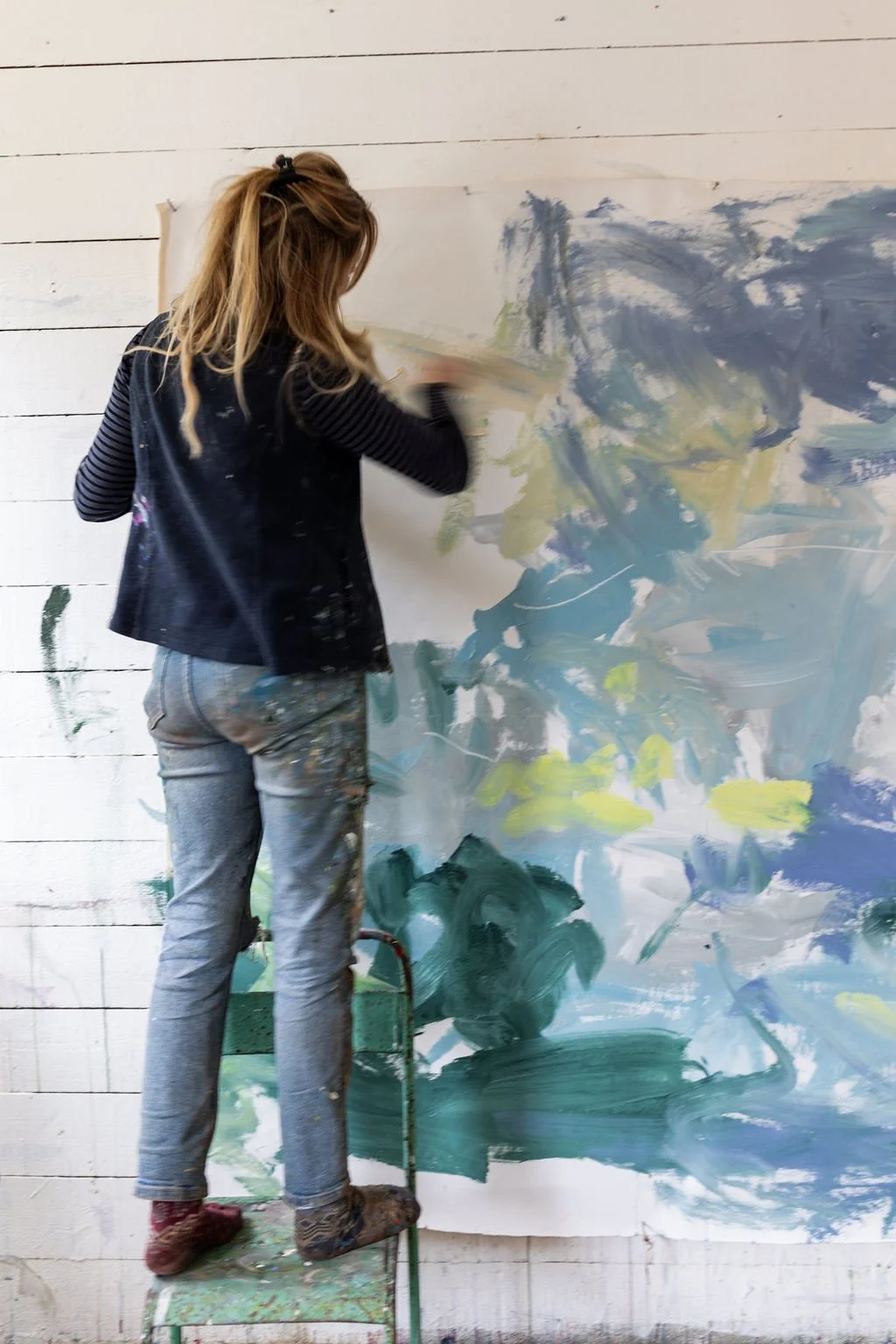
Studio Sits with…
Ewan David Eason sits down with Ariya Pereira
Ewan is sitting in his studio, about five miles away from me. I am sitting in a soundproof box in our Farringdon workspace. We have never met, so, as Londoners, we begin the call the only way we know how: the weather. Today has been noticeably colder than the rest of the week, and Ewan tells me he shaved his head this morning and is now regretting it.
He disappears for a moment. He comes back wearing what I can only describe as a vintage leather cowboy hat, smiling. He tells me he's going to start wearing it more often, it blocks the sun and keeps his head warm. Two birds, one hat.
I confirm that this hat detail will in fact make it into the interview. Then we begin…
You've said your gilded map works are a form of "art-as-documentation", a snapshot of a landscape that could be completely rewritten within a decade. Do you think of yourself, then, as making historical records as much as artworks?
I think inevitably, because I’m making maps, I’m documenting a city at a particular moment in time. At the moment I’m working on a commission of Dubai, and when I went back to the mapping I had from 2017, I realised just how dramatically the city had changed. So I started compiling all the up-to-date roads and notable buildings.
I love looking at old maps too. You can disappear down a black hole looking at how a city has changed over hundreds of years.
At the same time, I’m removing many of the things we normally use to navigate a map — names, words and sometimes roads. Once those anchors disappear, something very precise and recognisable can become almost completely abstract.
That’s the tension I’m interested in: documenting a real place very accurately, while also creating an artwork that can exist independently of the map.

Ewan gilding ‘Sacred Booth’, 2025, London.
Henry Ward sits down with Ariya Pereira
Henry Ward answers from his home in London. He is measured, thoughtful, precise without being distant. He strikes me as the kind of person who has spent a long time learning how to look at things carefully, including himself. On his website, his practice is divided into three: studio, shed, kitchen table. It's an unusual way to describe a life's work, and a good place to start.
I ask my first question.
You maintain three distinct sites of practice, a studio, a shed, and a kitchen table, each with its own pace and way of working. How do you know which space a particular idea belongs in, and do works ever migrate between them?
I think that my reason for making in each space is more dictated by routine and circumstance than a particular motivation to make a particular kind of work. With the studio I would, ideally, go every day and I do make a range of different work there, and have many works in progress at any given time. But I can’t get there every day and so the shed became a space out of necessity. I do usually do some painting in the shed most days, even if only for half an hour, or even shorter snatched moments. The context of the space dictates the sort of work and approach made. The kitchen table is less about this, I just happen to have made most (but not all) of my objects sitting at it, but I do make the same kind of objects elsewhere too on occasions…including in the studio.
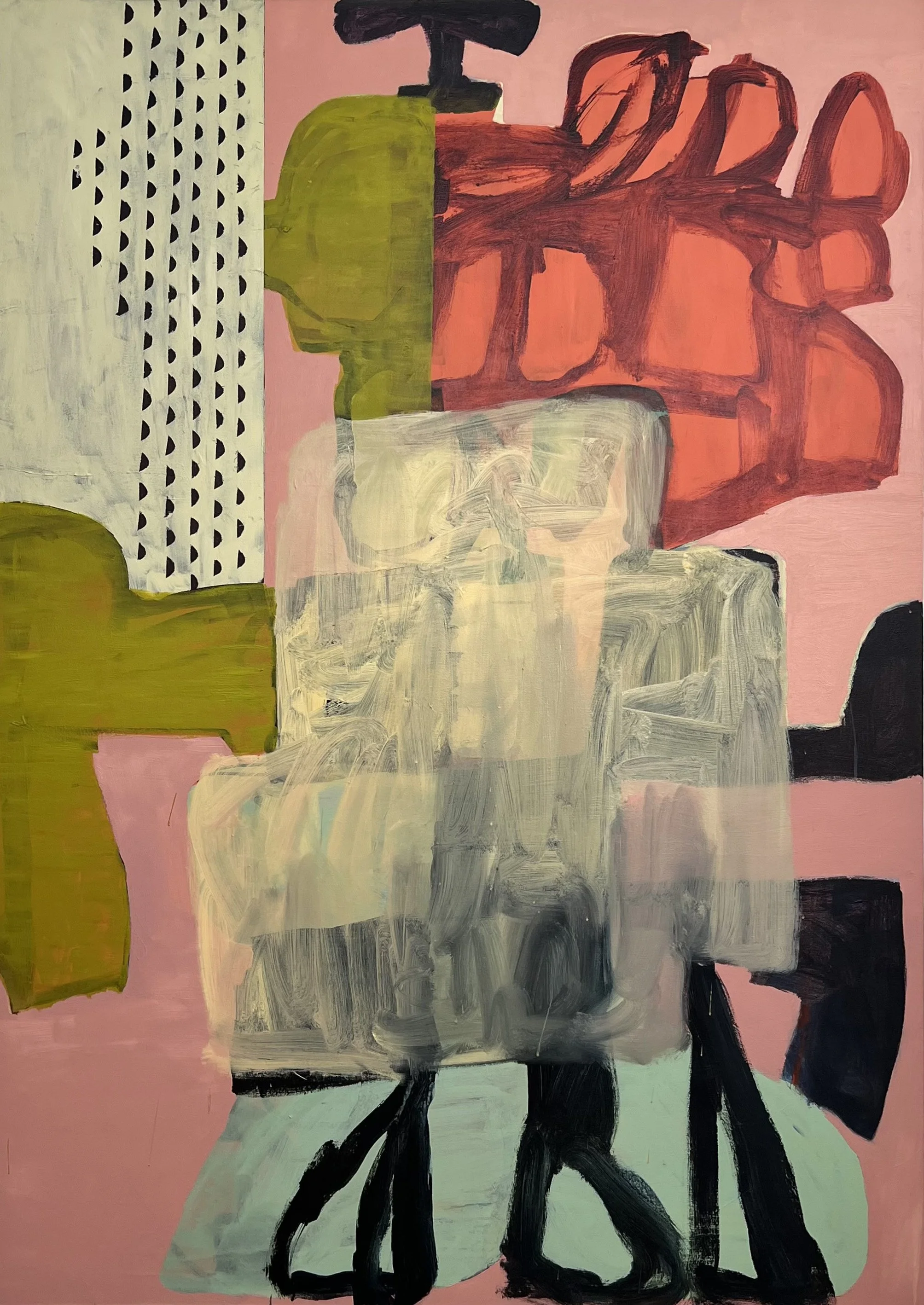
Crucible, 2025
175x125cm
Bethany Holmes sits down with Ariya Pereira
Bethany welcomes me into her studio in rural Essex. She is warm, candid, and refreshingly unguarded. Her paintings, large and visceral and alive with colour, fill the space around us.
Before we begin, I find myself complimenting her website. She laughs and tells me about the process of writing her artist statement.
I got Matt Retallick to write what is basically my artist statement. I think with artists we have everything up in our heads and we're so passionate and enthused about our own work, but I could just never get those things down on paper. I didn't want it to be some AI rubbish, so I sat with Matt for about two hours and he interviewed me, which was like therapy, really. It was so interesting to zoom in on why I actually do things.
It's a fitting place to begin. Because for Bethany, the why behind her practice is everything.