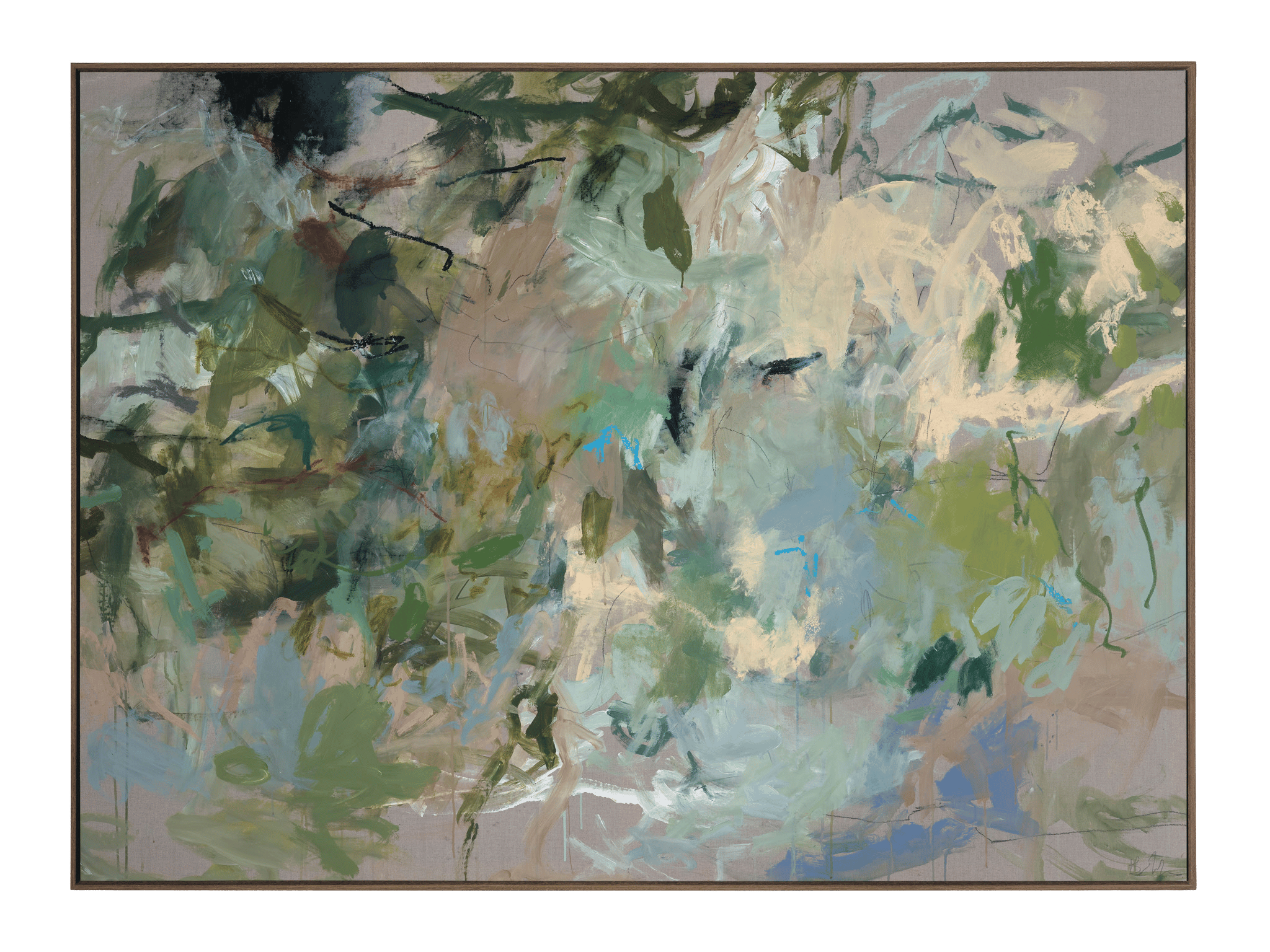
In your short biography, Matt Retallick writes that in your work, ‘tones are recollections’, do you have an innate idea of which colours and tones reflect certain feelings and moods?
It's more about what's going on within my life at the time, and certain things I see within nature, or just my everyday comings and goings. Something will pop at me and stand out to me and that might be a colour or a particular mark, something just comes forward in my mind: it's there and it keeps recurring. It will recur in my work and in the process of painting. Colour wise, it might literally be the most acidic green that I see out of the window one day and without realising, it comes into my work.
Take a collection of my work, maybe I don't think there’s any tie between them, maybe it's not a link directly, but often I later realise
Take this blue.
Bethany points to a work on her right
I remember this so distinctly being a colour that I kept mixing in 2024. Why was I drawn to that? I later realised that at the time my studio was on a farm and they were growing cornflowers at the back!
It’s often not obvious at the time, but a year later I can look back and spot if there’s a tie. It's so clear to me now in that body of work, that’s the colour I was drawn to at the time - it might have been the cornflowers. Often my mind takes visual colour snapshots and I become obsessed with those segments of colour that meet each other.
I think colour is such a driving force for me.
I'll experience a section of time where I might be drawn to a particular palette or a relationship between two colours meeting, and then I just become so engaged with that, it’s like an addiction, I love it. So in my head that kind of reflects what Matt was talking about. It’s not that I paint blue because I’m sad, it’s more that in my subconscious I see colours, colour’s meeting, colour’s reflecting. Then I look back on a specific time and I see that was a period where I became obsessed with this particular concept of colour and creating a palette around that.
How is your selection of colour guided by your internal word? Do you see something and it goes through you into the canvas?
I think it's a very subconscious thing, most of the time I don't realise it.
This has only occurred to me recently
I went on holiday with my nephew when he was 3, you know when kids draw birds and they do ‘m’s’
Bethany draws with her finger in the air to show me, I laugh and nod.
When I got back to the studio, I just kept doing these marks in my painting like that. At the time I kept asking myself, ‘why am I doing this?’
Then on reflection, I remembered sitting and drawing with my nephew and I thought, oh! That’s clearly had an impact on my work. At the time, I couldn't correlate the link.
I never plan a painting, I can't start with a sketch. I need that intuitive process that comes from within. I don’t need to think when I paint, I just need to get in the studio and see what happens, then I just work through it.
Planning for me just wouldn’t work. Even if I planned down to sizes or scale, in my head it becomes a battle. A gallery might ask me for a specific size of commission, I feel an urge to rebel against it. I’ll paint on linen that's larger than the given size and then get the framers to stretch it to scale.
Do you even plan when you are going to paint then? Do you set aside time?
I used to be very intuitive with my painting, when I felt like it I would just paint for a whole day.
Then I had children, which threw a spanner in the works…
It’s actually been an incredible experience with my second child because with my firstborn I got pregnant and I didn’t want to paint at all. For the first time in my life I struggled with my creativity, I got really anxious when I went into the studio, it was a very weird time. With my second, I thought to myself, I can’t just stop painting, this is my livelihood! This is ridiculous!
It was such a therapeutic 180 because I got into the studio and I had the best time. I created what I think are now my best works, and since then my work has progressed so much . My baby is now 9 months old and during this period I have two hours to paint during her nap time. That, for me, is the perfect tight schedule to think to myself, ‘you haven't got long, so don’t mess around, just get in there and get it out and you’ll feel so much better!’
Five days a week that’s how I would paint. I get minimal time in my studio, so when I get in there now, the time is very special to me.
Wow, so even your process is so deeply personal, would you say it's cathartic in lots of ways? Is going without painting now unthinkable?
Going without it is not even an option now. I wouldn't be able to cope, it’s my therapy, my time. I crave it when I can’t be there, and spend moments looking at shots from the studio and wondering my next moves with paintings.
From a personal point of view it's an incredible experience to be in my studio knowing that my daughter’s asleep, where I can have a kind of therapy of emotional release.
It’s such a special part of the paintings that are coming out of the studio now, of their growth and how much they’ve changed.
My daughter’s birth and start in life has played such a part of my current artistic process and I’m making what I feel are the best paintings I've ever made. I go to the studio with so much rawness and energy, passion and fire. It feels like I have this wonderful creative happiness that is overflowing out of me, and I don’t ever want it to end!
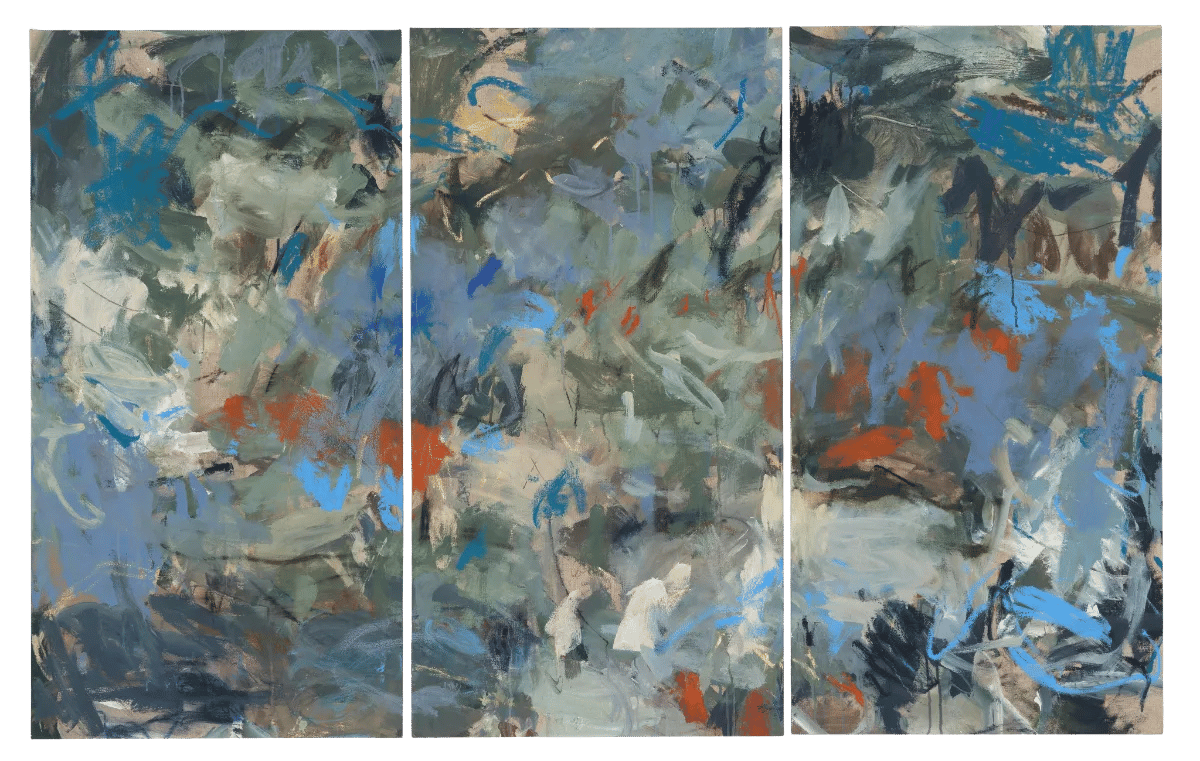
Retallick also mentions this phrase, ‘perfect imbalance’, What does ‘perfect imbalance’ look like to you? How do you know when a painting is finally finished?
He nailed it with that phrase.
I'm often searching for the painting to be balanced, I’m searching for the colours to have a relationship together, I’m searching for the painting to grow with layers, to become its own identity.
At the beginning of the process I’m making marks and responding, it’s quick, playful and energetic. Then the kind of middle process is where you’re building the colours up, building the concept, building what’s happening.
Then the end process is the slowest. I’m finally thinking, I’ll do a mark then take a few steps back and just sit and stare at it, come back to it, make another mark and repeat. It’s the longest part of the process and it will take hours.
It’s finished to me when it means something but it feels like it’s not perfect, it has an edge.
I like my work to have a palette that’s cohesive, that has a feel, but then I’ll throw in a colour that just takes it somewhere else and it becomes a little more nuanced. The colour will go with the palette but you’d never think to use it. I always know what colour it has to be to make the work say something else.
It’s a constant battle between me and the canvas but you need to know when to step away.
So for me, a piece is finished when it's not what you expect: a perfect imbalance of colour, concept and composition.
Your paintings are influenced by nature, your studio is in rural Essex, but they aren’t depicting nature. How much of your work is also made up of memories and dreams?
I think it’s difficult because as an artist I feel you always have this pressure to define yourself. When I started, I felt like I had to say I was a landscape artist, I don’t really know why.
Now my work is in no way depictive of a landscape, I’ve accepted that. It’s now very much a process of emotion and response.
The other day I kept seeing this long grass.
It was so beautiful blowing in the wind so I took a video and close-up shots. I didn’t do anything with them but then I was in the studio and before I knew it I started doing these lines over and over.
That was the start of the painting, in no way was I drawing a long grass, but it was those lines, the way they moved and marked the page, I could see the grass starting to come through and the vertical nature of that grass, the height, the impact it had and now this has started coming into my work.
Perhaps in the initial base layers I'm getting everything in my head out. I’m not thinking but just enjoying the process which is probably my subconscious coming through. So in that sense, it has a very loose reflection of what's going on with the landscape at the time.
The way a painting builds up initially is so subconscious, its all feelings and responses to things going on in life, to nature. Then as it builds its more of a slower process of responding to the colours on the canvas, responding to the relationship between the colours and seeing it evolve.
In the videos of you working, I notice you use a mix of paintbrushes, your hands and scrapers to scratch paint off. It seems you are in a trance-like state. How much of the process of creating for you is a physical one compared to something mental or pre-conceived? Do you feel the work in your body more than in your mind?
That’s a good question. I think initially the paintings are very physical, I'll be sweating in the studio, especially in this weather!
It’s a very physical process, especially because a lot of my canvases are so big, I want it to feel like it's part of me, that it's grown with me.
Someone said the other day that the top left section of a 2m x 2m work of mine hadn’t been worked on as much and did I want to use a ladder to add to it. To me that’s the point. I can’t reach there so that’s part of the painting, the restrictions of painting to that scale, the imperfect balance.
I’ve given my physical self to so much of the canvas and that's how it’s responded and grown. I can’t reach that bit and that’s part of the painting and the process. I guess that’s physically how my body gets into the work.
Then, as we’ve said, it becomes more about my mind working with the colours.
There’s a lot of covering up scraping back, whereas towards the end of a piece I'm taking more moments to step back, stop, breathe and then go in again.
Finally, a question we want to ask every artist, do you have any studio rituals that you do or any ways of marking transitions or changes?
Okay so if you were a business coach, you’d tell me, this is such a waste of time and money but I will never stop doing this because it works and it's just part of my process.
I work on unstretched linen, and then at some point I think, ‘I'm happy with how this piece looks, everything feels comfortable, it's ready to be stretched’.. At that point I send it to my farmers and they stretch it.
I could stretch it, but I don’t because I need that time away.
We discuss size and then the stretched works come back to the studio a week or so later. I either finish them through that slower process, where a few marks can unbalance the canvas and then suddenly it feels done, or I just completely screw them up and it takes me years to finally get round to finishing those paintings.
Having the canvas stretched creates an edge, a finishing line.
Once I feel happy with them they go back to the framers to be framed.
So it's kind of financially stupid - it takes more time, money and it is a gamble, as sometimes the works come back stretched and I dislike them, and re-work over them! But it's such a good process and it's become how I have to do it.
I need the time away from the work and once they return to the studio, the composition has changed, there’s a limit on it. It shows me a work’s balance more clearly and that’s how I know when to put a line through it, or draw over it or mess it up a bit. It’s almost like I take the unstretched canvas as far as I can, and then once it’s been stretched it's exciting again, it needs to be messed up, shaken a little, ensuring it’s not too balanced, too perfect. It needs that rawness.
The going away, coming back, going away, coming back; it's all part of the process. It's a bit mad but it’s part of every painting.
So how do you know when a work is finished?
Okay so I cut the stretched linen, I play with it, but as it's starting to talk to me and as it's starting to slow down I stop. It’s almost balanced at that point. Then I send it away to be stretched. When it comes back, instantly I know how to progress because I have sat with it in my head.
When it returns it's almost a different painting. I haven't chosen how to crop it (unless I feel it needs to be cut up!) they stretch it with a rough size I'll give, so it looks completely different to how I sent it off.
I’ll then go back into it, rework it, and I'll know when it’s finished because it will feel like it clicks and it's talking to me. It’s doing something it wasn’t doing before. It’s more edgy. I think that can only be achieved after it comes back.
What’s the most important aspect of this finishing process, is it the distance and the time and the space, or is it that it’s coming back slightly transformed?
Slightly transformed. I hate working on pre-stretched canvas. I just can’t get on board with it because I feel like I'm being told what size to work on. I hate being told the specific parameters in which to work. If I have a commission I will cut a larger piece of linen than the work size, and my framers will then cut it down to the right measurements to stretch. It just helps me that I don't have to work to a precise scale.
When a commission piece comes back and it's at the right dimensions for the client, I can then work on it because it already feels like a piece in its own right.
Is it the structure that you don’t like, the way something’s set?
Maybe? Maybe this is me taking my chance to rebel?!
I think it's the restrictiveness. I hate the fact that with a pre stretched canvas you could do a mark and that it has to end, even though in my heart, I want the mark to continue. I also love that when you do a mark on an unstretched canvas and then you stretch it, you see it go around the corners to the back of the work.
To me, that’s the story of the work. Maybe the client might never know that's what happened, often people don’t look at the marks around the back or the rough edges, but to me that’s also part of the process: a line that has continued around the painting and continues around the back. There’s more to a painting than the visuals on the front. There’s a whole story - yeah that’s it - gosh it’s like therapy again!
That’s such a nice idea - it’s like a testament to something.
Exactly, and this way you know that even if you change the front of the painting dramatically, there’s always those marks around the back. The core, the really raw marks that led to where this painting is now.
Leaving Bethany's studio, it strikes me that this is precisely what makes her work so affecting: the sense that each painting is not merely made but lived through. Every mark a response, every colour a memory, every finished piece a layered record of time passing. The canvases lining her walls are not windows onto the Essex countryside, they are something more interior, more honest than that. They are, as Matt Retallick so aptly put it, recollections.