
Nick Hirst sits down with Ariya Pereira
It’s a crisp morning at Nicky’s studio in Camberwell. She has two salted caramel canelés on the table and the kettle is boiling. The room is long and filled with things found and forgotten; a row of cinema seats, pieces of a child’s playset, leaning towers of books, tassels, trinkets and sieves. I am very excited to begin.
You've described being haunted as a child by the idea that a giant squid could blanket Piccadilly Circus, and that there are more atoms in a cup of water than there are cups of water in all the oceans. For me this is indicative of a kind of fascination with scale and disproportion, would you say that’s at play in how you look at and relate to things?
I love the ridiculous enormity of those statements. They do that same thing to me as looking at the stars and the sea. I get really overwhelmed by enormity, so I generally like to keep things simple, low key and uncertain. When a children’s science book told me those ‘facts’ I remember it being very alarming. In 2017 I had an exhibition at Domobaal called ‘Real Size’, where the title of the show came from noticing statements like ‘not to scale’ in an advert, or ‘objects in mirror are closer than they appear’ as a wing mirror safety warning. Perhaps, now more than ever, nothing is as certain as it seems! I quite enjoy this position because then maybe anything is possible?
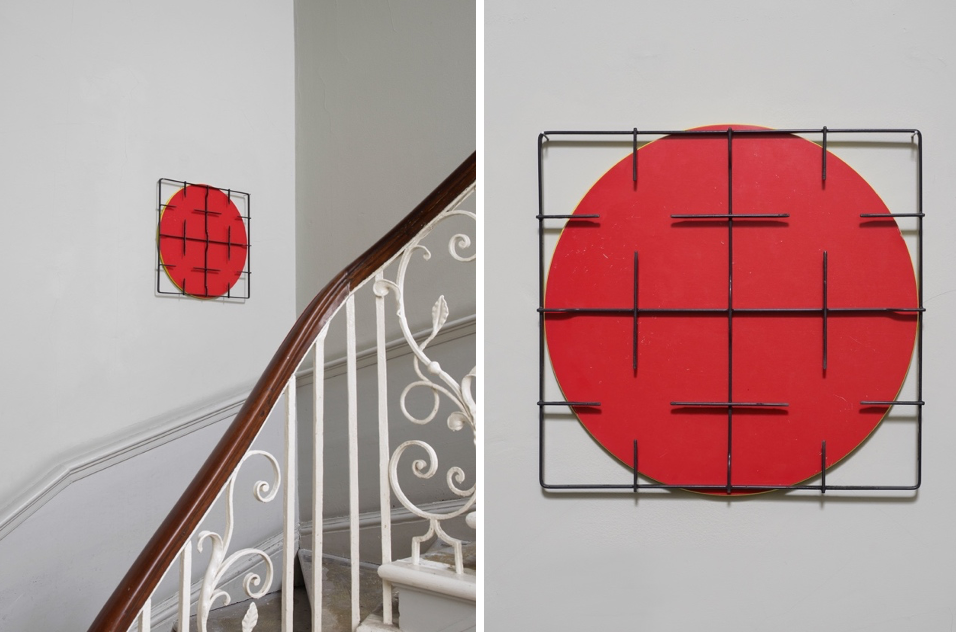
‘New World’, 2017, gas cooker hob pan stand and a child’s tabletop, Government Art Collection.
Your practice spans drawing, sculpture, collage, photography, and public commissions. When an idea arrives, how do you know which material it belongs in, or does the material come first, and the idea follows?
Most of the time the context decides the material. I am currently working on a commission for a forest, which means the works must be relevant to the site, resilient to touch, weatherproof, and not too vulnerable to theft. At the moment its looking like we will go with cast-iron sculptures on locally sourced sustainable timber plinths. The work I made for the Oxford University Biochemistry building was for an external glass façade which needed over 50% coverage to control some of the solar heat gain in the entrance area. ‘The Glass Menagerie’ work I created was ‘fritted’ or screen printed onto the glass and referenced what was happening inside the 24-hour building. My approach drew an analogy between the ordered and systematic processes of science, and the moments of chance and serendipity when a connection or discovery is made. The Rorschach Inkblot Test is a visual motif that references ideas of perception, order, symmetry and opposition. The Test is scored largely on how you see rather than on what you see. Meaning is not arrived at through explicit imagery, but rather through subtle perceptual and cognitive paths. It is designed to evaluate how someone approaches their environment. It asks the question how does someone view and organise the world around them? I like that the scientists say things like, ‘meet you at the entrance by the squashed spaniel’.
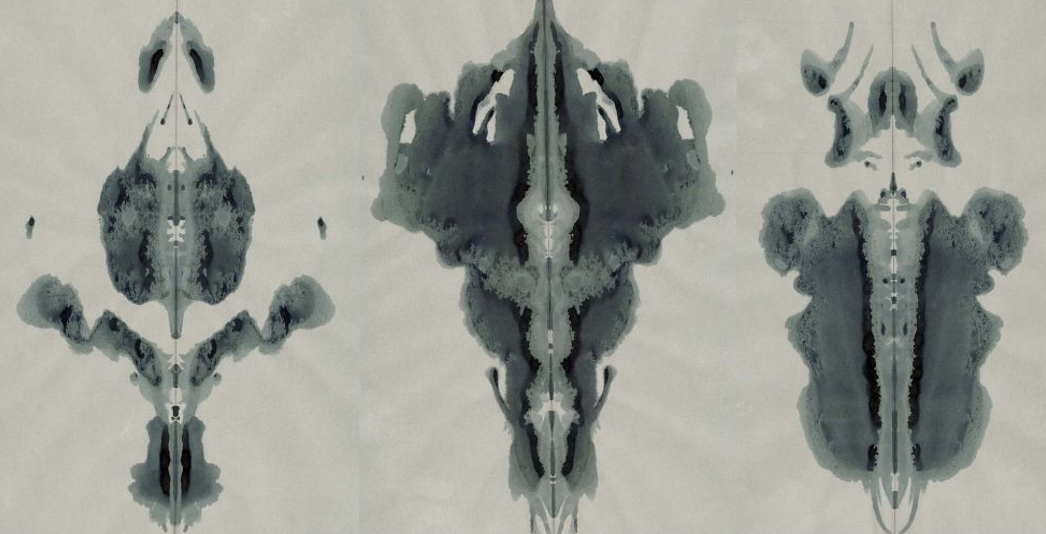
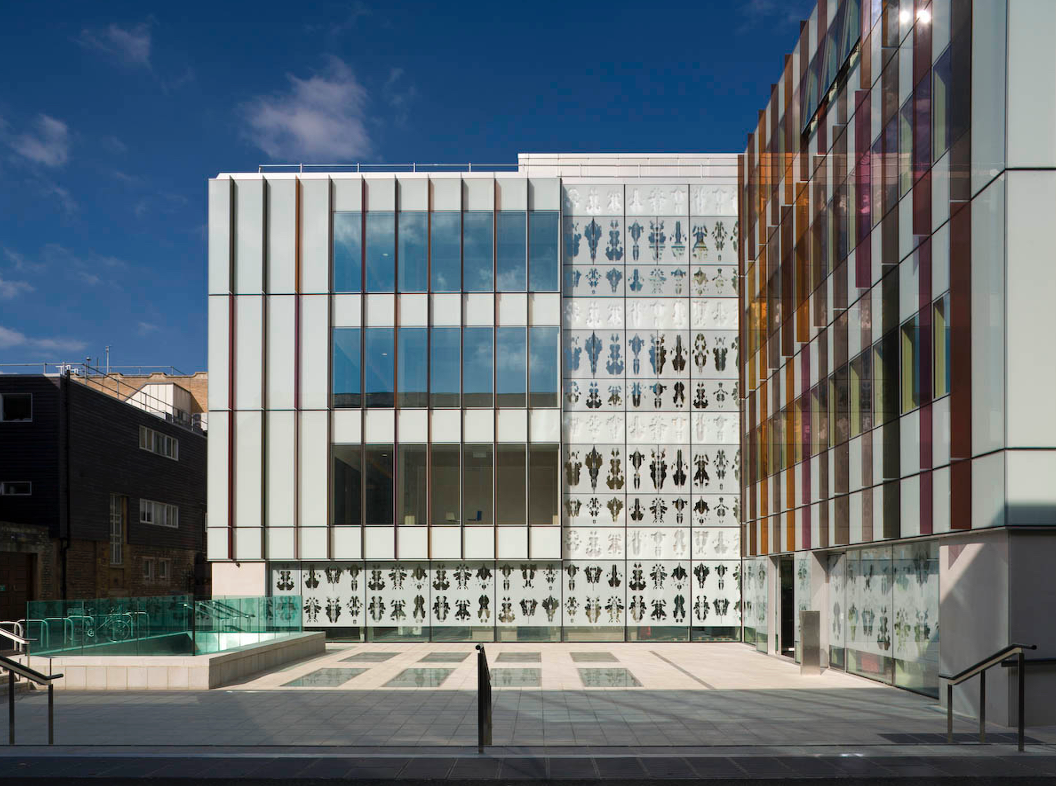
A sample of Hirst’s controlled experiment of ink drops on tracing paper which were then translated onto the glass façade.
If I am making work for an exhibition I usually use found objects which then lead the way materially, in that the material suggests what the work will become and I will follow its lead.
I love your affinity for found objects and materials, the way you shift their meaning through context change, or juxtaposition rather than invention. How do you tell the difference between something that's just discarded and something that's waiting to become part of a work? Does that distinction even exist?
Potentially I think anything can become a work. Though I am quite selective at the finding stage because I don’t want a studio full of junk. I definitely edit on the hoof. Recently I took part in a residency at Newhaven Art Projects. I went with no expectation or materials and not a thought in my head other than to respond to what I found there. I had such a productive week, walking, looking and gleaning the area around the gallery. Each day I would return to the space and make. The works became a portrait of my time in Newhaven. I don’t think everything I made was art that could stand up in another context, but everything seemed valid to me as a response to the task I had set myself. Objects were in flux and for one day only, were presented as an exhibition.
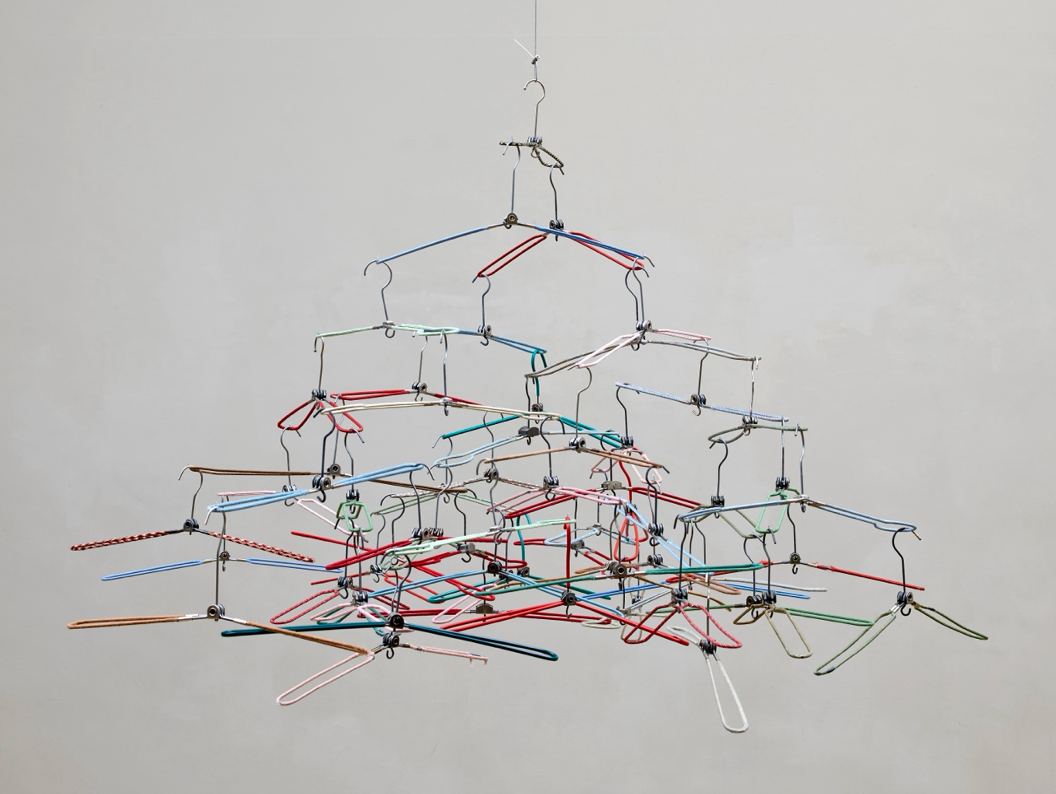
Eleventy, 2022, metal and fabric.
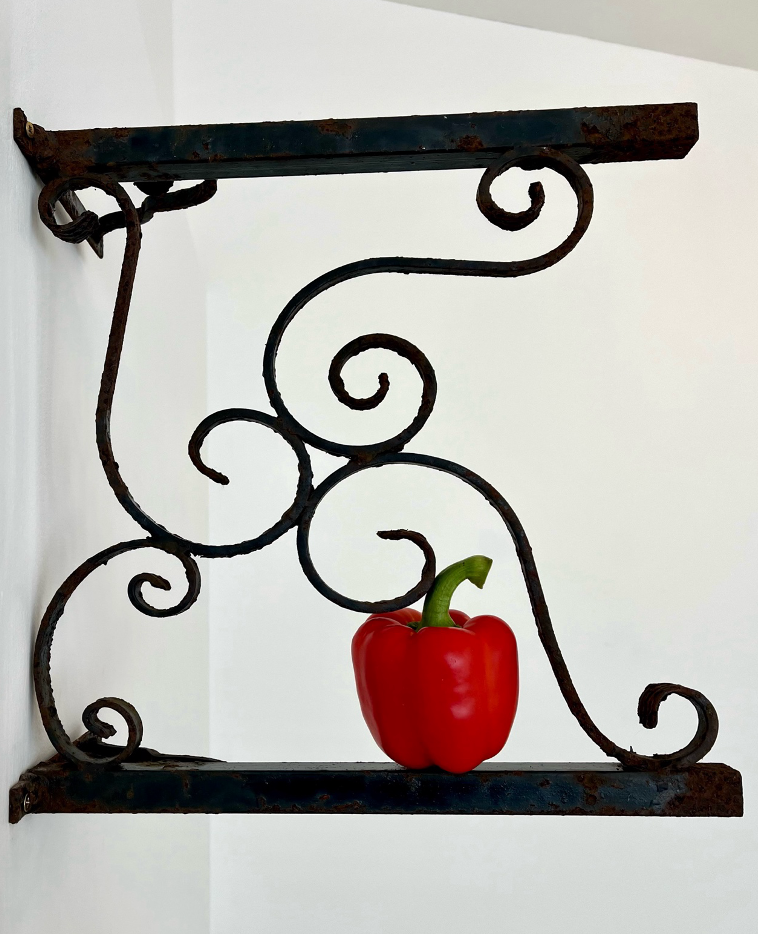
Found wrought iron and red pepper courtesy of the fruit and veg stall on the High Street, Newhaven.
I love your piece with the pepper.
Thank you. That was just a bit of cast iron all rusted away which I cleaned up and then there was a lovely fruit and veg market stall where saw the curve of the pepper and remembered cleaning these curls. I put them together and it worked.
Do you think you’ve really honed your eye to spotting both the shapes and pairs.
Yes, I think so. All those shoe boxes over at the end of the studio are filled with images of animals, buildings, trees, people etc. In 2012 I began an ongoing series called ‘Elemental Works’, which has now reached 336 works. They are visually paired images; duets borrowed from magazines and books. Once removed from their original context the images become the medium, they are forms and colours to work with. The shapes of the diptych are felt rather than thought. The limitless photographic pairings create new unspoken narratives, each with its own internal logic. My parameters here are that the pages must be found and of a particular size. It makes the challenge harder but to me it would be cheating to print any image you like at the right size. The resulting works are in the tradition of ‘assisted readymades’.
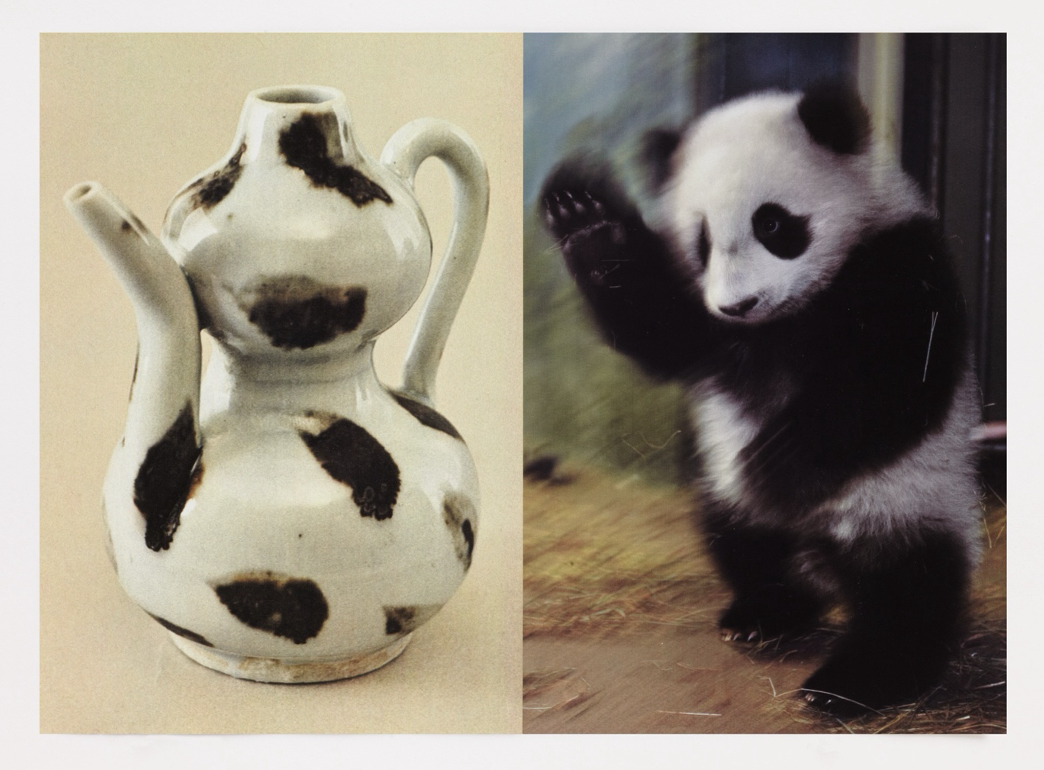
Elemental 85, 2013, paired pages 34 x 25 cm.
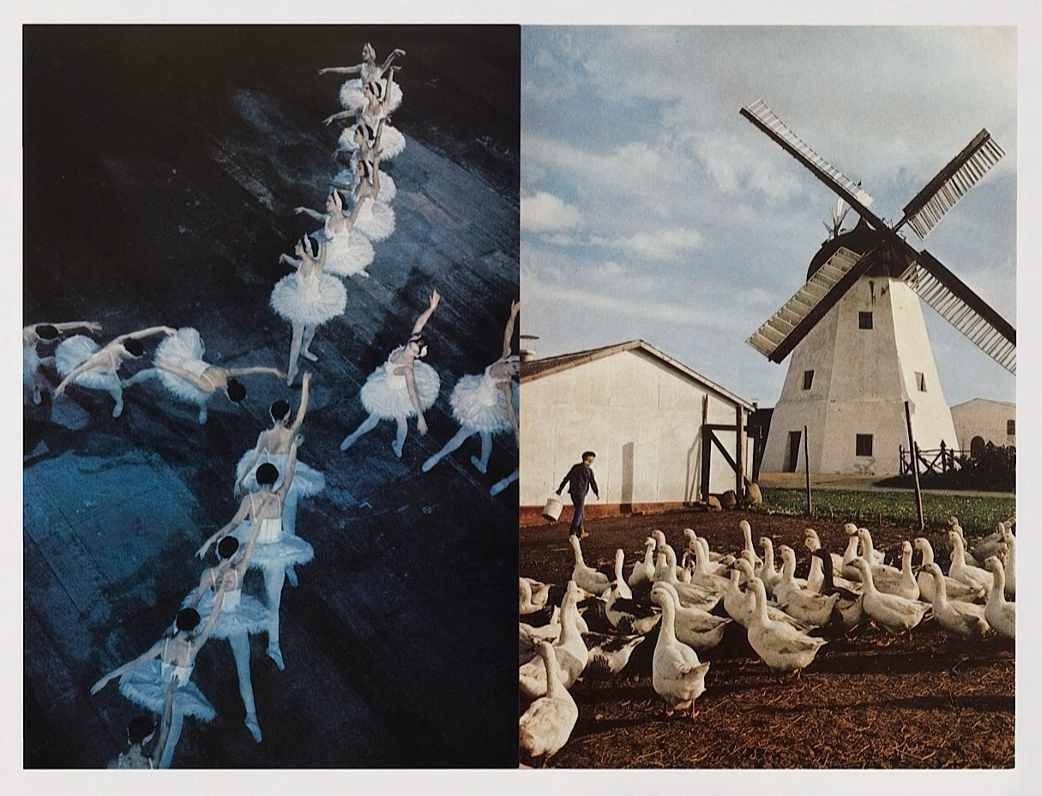
Elemental 64, 2013, paired magazine pages 34 x 25 cm, Ashmolean Collection, Oxford.
I have been doing the act of ‘looking’ in this way for a long time. Sometimes I wish I could look at things and not wonder what I could do with it or create from it.
Do you look at objects with potential, then?
Always.
Do you pick up objects with an intention of meaning?
I once made a piece of work, it was a tabletop that folded in half, like a little tent with a hinge down the back. Inside there was this skin pink balloon that sort of wedged it open, it would collapse unless the pink balloon was there and it was so tender. I wanted to make something really tender. My friend saw it and she burst into tears. I think with that piece I definitely saw the tent shape of the table and knew where I wanted to go with it, so occasionally that does happen. I suppose it told me that it was some kind of shelter, so I wanted to make it more so. It was a really strong rubber balloon, so it never popped, but slowly over the course of the show it deflated. You had to put a new one in every few days.
That sounds like it was almost breathing!
Yes, I suppose you could leave it to just gently collapse over a few weeks.
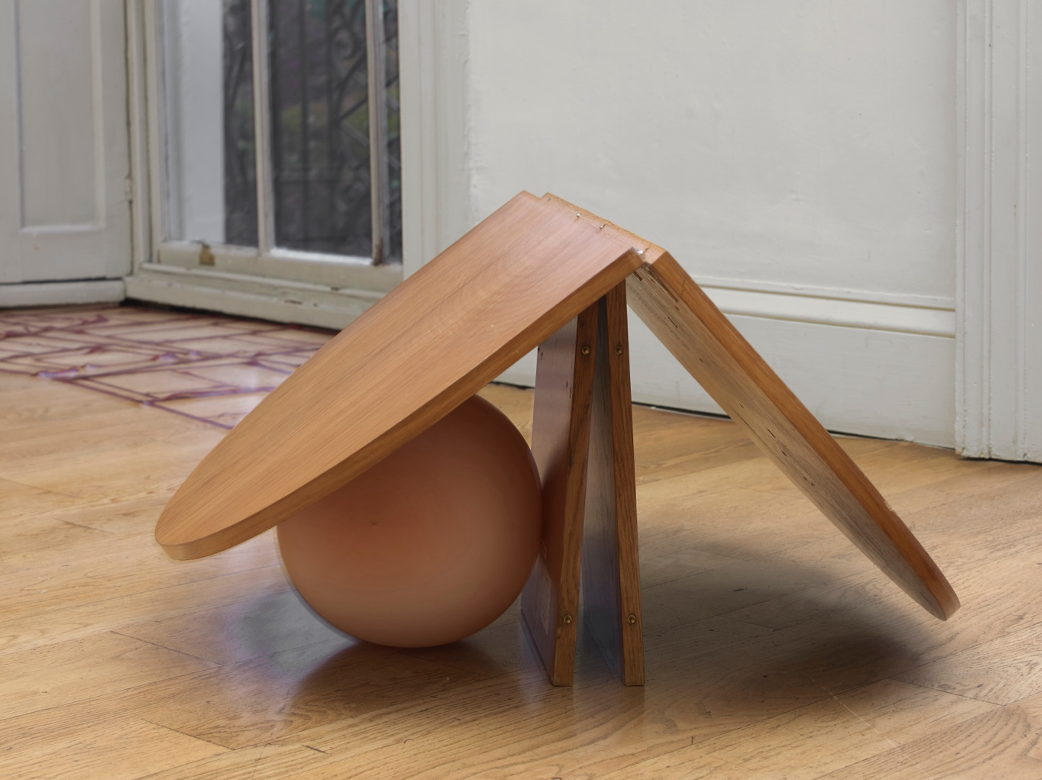
Pinch Point, 2022.
The anagram poems feel like a very particular kind of constraint, rules that limit you but also, as James Peto puts it, "liberate" you. Do you enjoy the discipline of a self-imposed rule, or is it something you have to fight against?
I really enjoy the discipline of boundaries because then there is something to push against. If I feel I can do anything it all gets a bit flabby. Someone once described Ancient Latin to me as a finite language, and I found that so exciting and thought one day I would love to learn Latin. Imagine knowing a whole language. I just fact checked what I was told and found, ‘The Corpus is Finite (Closed) - because Ancient Latin is a ‘dead language’—meaning it no longer has native speakers and is not naturally evolving in everyday society—its historical record is fixed. There is a specific, countable number of words preserved in surviving classical texts, inscriptions, and grammatical records.’ How great is that?! Anagrams are similar, in that there is a finite amount or words you can get out of a set number or letters. When I made an anagram poem using Donald Trump’s name (because of his childish name calling), I called it ‘What’s in a Name’ and interestingly there was very little I could find within it that was positive. I don’t know if that was my bias or a ‘fact’.
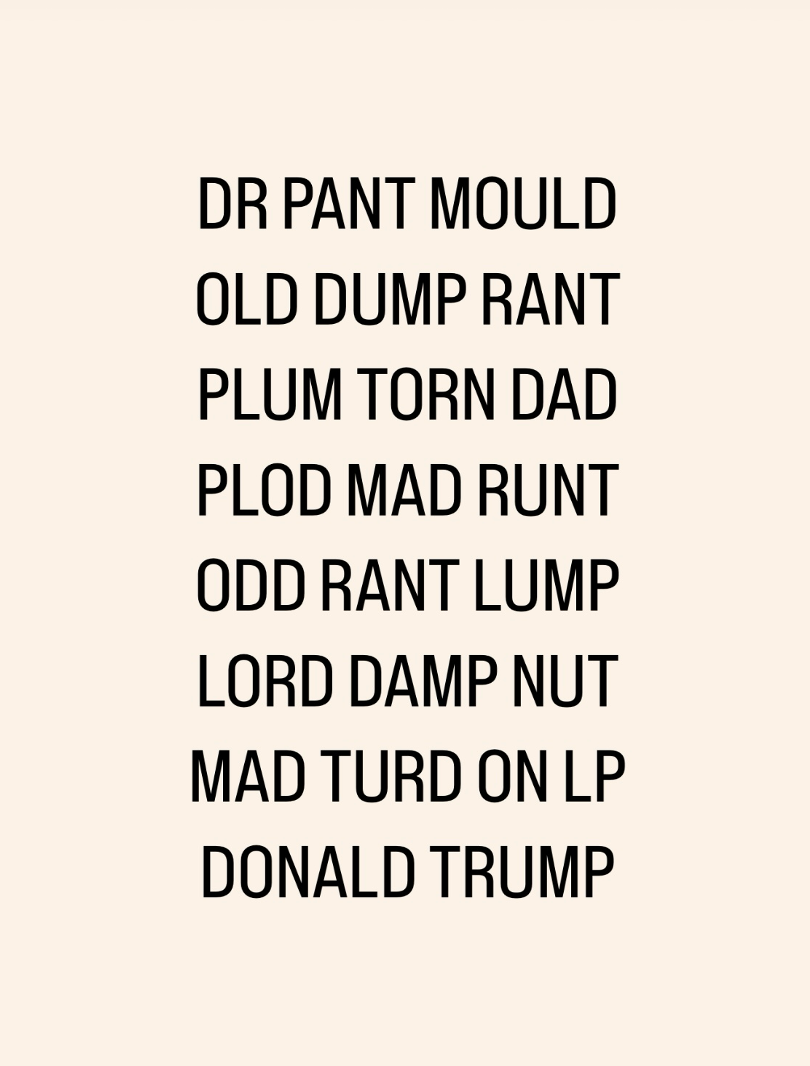
Oooh, maybe there is something in a name…I like Latin because, like you say, it is a ‘closed’ language, and yet in the translation of it, so many possibilities for meaning arise. It’s both closed and open, which makes me think about your anagrams, that there might be things in there still hiding.
I actually like to put my chosen words through a search engine in order to see all the possibilities for an anagram. I have to believe that it gives me all the words within a certain combination of letters because that’s what it tells me. Sometimes I do exhaust it, when I know I’ve used every possibility.
What is it about that knowing that appeals to you?
Really, really knowing something is quite comforting. I’m no good at maths but it must be quite nice in having resolute answers. Having some kind of answer that you know is ‘true’.
David Lillington writes that you "suggest a number of possible metaphors but fulfil none of them." Is that elusiveness something you build in consciously? Do you think about how a viewer might "misread" a piece, is it possible to “misread” a piece?
I don’t think anything of mine can be misread as I am only 50% of the conversation, in that I do believe the viewer completes the work by whatever they bring to it. I’m definitely not trying to tell anyone anything. The forest commission I mentioned is highlighting how endangered conifers are at the moment. You have to get that message across so it’s about making something intriguing enough for someone to think, why would that be there and seek out the answer.
So you’re not telling, you’re prompting?
Yes, I suppose I’m prodding. I have on my Instagram, ‘Pointing at stuff and conflating things’. I think that is the role of the artist, to say: look underneath here, look around the back of this.
It made such sense to me when David Lillington said that back in 1991 and it has been useful ever since. I also like the word conflate ‘to combine two or more separate things, ideas, or texts into a single whole, or to mistakenly treat two distinct things as if they are the same.’
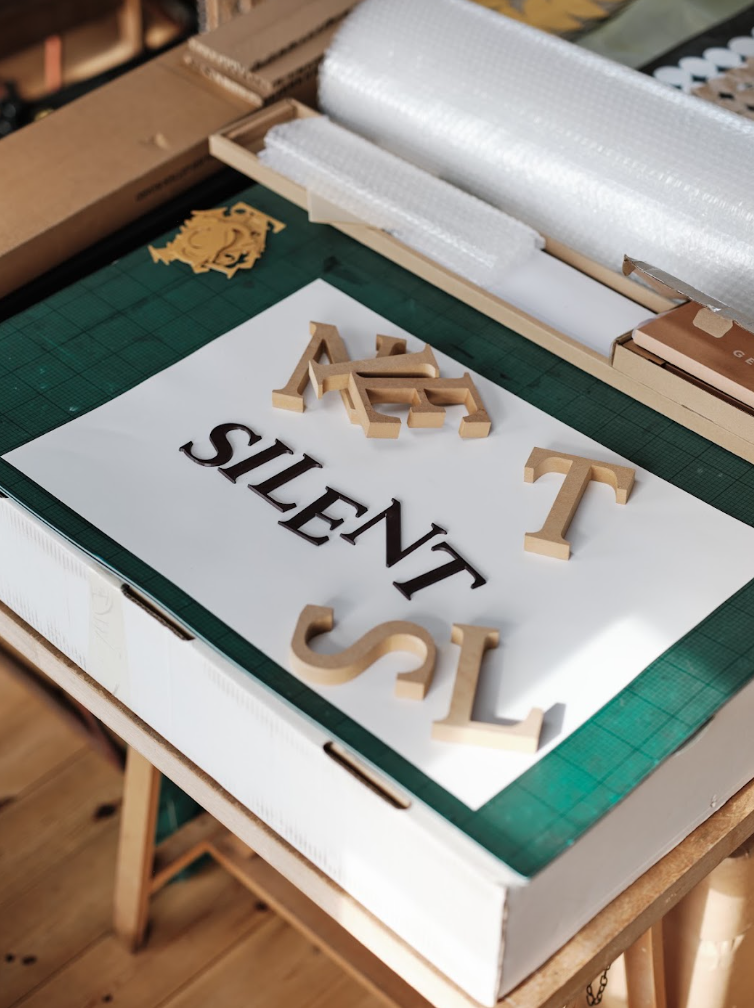
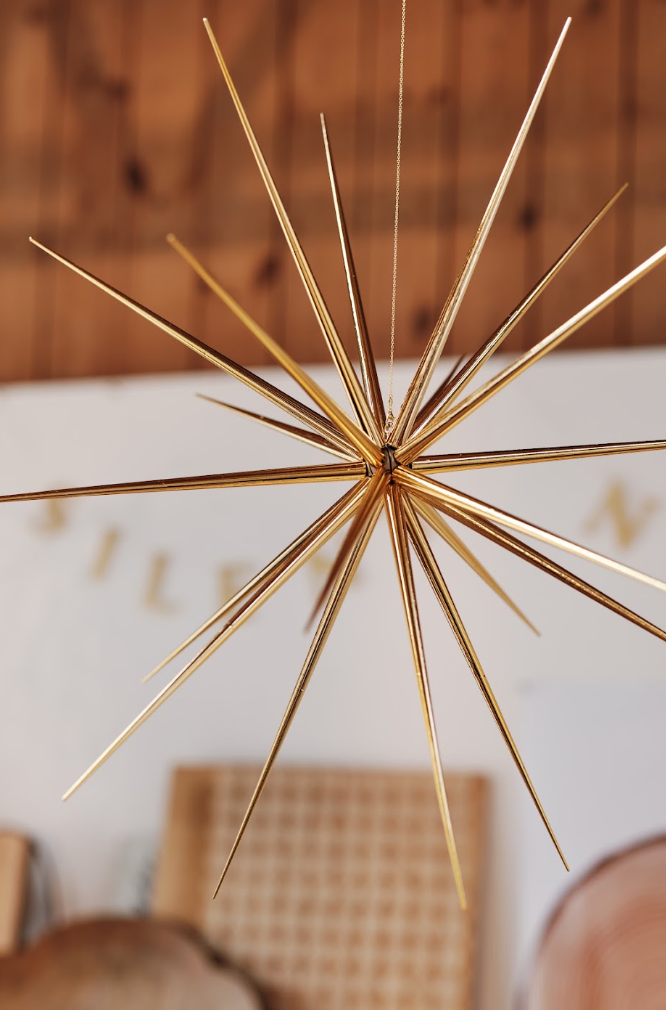
We have been working together on a commission for Christmas, which we are all very excited about. Was it difficult to create something which speaks both to Christmas as a holiday but also to your own practice?
I’m excited too. The hotel is such a glamourous context for me. Working on the Christmas tree has been like working on any commission, in that there are precedents, research, constraints and timelines. I have enjoyed our meetings and discussions and am very happy with what we have arrived at. Given the hotel’s international audience, I was keen to keep the tree feeling open to interpretation, rather than drawing too directly on any one particular story or tradition. It references the context of a hotel and will be full of festive tropes, sparkle and absurdity.
The context of the hotel means the tree has to have multiple functions; it has to operate as a decorative and festive tree whilst also having integrity as an art work.
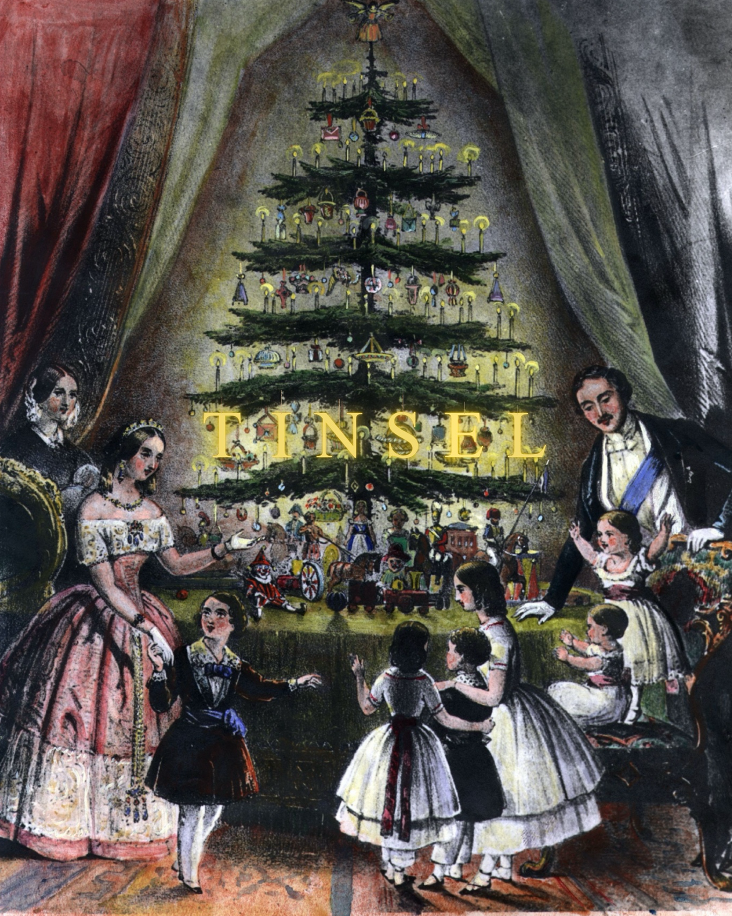
Was it fun to take an artistic approach to something like a Christmas tree? One of the images you used for inspiration was the Queen Victoria and Prince Albert Christmas tree illustration from 1848, did you take any inspiration from historic Christmas traditions? Is your tree a playful re-imagining?
I had to constantly remind myself not to get carried away and make something too fun and frivolous. There needs to be some sense in the non-sense to make it operate as art. Hopefully I have the balance right. The engraving of Queen Victoria & Prince Albert’s 1848 Christmas tree famously popularised the tree decorating tradition and I was definitely drawn to its symmetry, branch tiers and neatness. Queen Victoria, Prince Albert and their children often had several trees which they made for one another. Each kept the tree they were making a secret, choosing all the decorations themselves, and then there was a big reveal. I liked the idea of creating a tree for others, of decoration as a gift.
It was interesting looking at artist Christmas tree precedents. Sometimes they don’t look like that artists work at all, but I wanted to treat it with the same intention as I would a museum commission or a gallery. I wanted it to fulfil the brief of being a Christmas tree, being seasonal with all the Christmas tropes, but I was still mindful that I wanted it to also look like my work.
Finally, a question we like to ask every artist: do you have any rituals or habits when starting or finishing a piece? A way of marking that shift from looking to making?
When starting a work I try and be as open and receptive as possible to the thing or story. I want to get myself out of the way and have the work tell me what to do – what it wants. I like the anacronym K I S S - Keep It Simple Stupid. When I think something is finished, I look at the work in a mirror. It’s the same but different and the looking glass world often reveals something overlooked or as yet, unseen.
It was a perfect way to finish our conversation, not with a neat close but instead, an open ending.
I leave Nicky’s studio with a head full of possibilities and playful contradictions, a canelé in my bag, and a determination to practice the act of ‘looking’. To see every object as a question, every pairing a prompt, every finished piece a little different when you catch it in the mirror.
It’s a habit I’ll carry with me to Park Lane, to a tree made with the same quiet intention. Neat, precise, playful, and made as a kind of gift, the tree is waiting to be looked at, hoping to be asked about.
Queen Victoria and Prince Albert and their children gathered around a decorated Christmas tree at Windsor Castle, published in the Illustrated London News in December 1848 – with TINSEL addition.