
Henry Ward answers from his home in London. He is measured, thoughtful, precise without being distant. He strikes me as the kind of person who has spent a long time learning how to look at things carefully, including himself. On his website, his practice is divided into three: studio, shed, kitchen table. It's an unusual way to describe a life's work, and a good place to start.
I ask my first question.
You maintain three distinct sites of practice, a studio, a shed, and a kitchen table, each with its own pace and way of working. How do you know which space a particular idea belongs in, and do works ever migrate between them?
I think that my reason for making in each space is more dictated by routine and circumstance than a particular motivation to make a particular kind of work. With the studio I would, ideally, go every day and I do make a range of different work there, and have many works in progress at any given time. But I can’t get there every day and so the shed became a space out of necessity. I do usually do some painting in the shed most days, even if only for half an hour, or even shorter snatched moments. The context of the space dictates the sort of work and approach made. The kitchen table is less about this, I just happen to have made most (but not all) of my objects sitting at it, but I do make the same kind of objects elsewhere too on occasions…including in the studio.
Your PhD focused on teaching as an artistic practice, and you've spent three decades in art education. How has teaching shaped the way you think about your own work? Do you think it makes you a better or more self-aware artist?
I’ve taught in different contexts for over 25 years and the relationship between my teaching and making has evolved over that time. To begin with I was determined to maintain my artistic practice alongside my teaching and so kept them as parallel pathways. This shifted as those pathways merged and my practice expanded. When I first started teaching I was a painter, as my teaching developed I began working in a wider range of media and the work became much more directly related to the context of teaching. Since leaving full-time teaching (though I have continued to teach in other contexts) I have returned to painting as my primary field. I think that there is a symbiotic relationship between teaching and making and find that the discursive space afforded by teaching (in particular) is a vital component in being an artist.
Your 2025 monograph Bethany grew out of your residency at the Albers Foundation in Connecticut. Josef and Anni Albers were so deeply invested in colour and process, did being in that environment change something in your practice, or confirm something you already knew?
Being in residence at the Albers Foundation, for such a prolonged period of time, did have a profound impact on my work. Having so long living and working in isolation and without distractions was tremendously formative. I don’t think there were specific Albers related aspects to this though. The residency is not about engaging with their practices, unless you want to.
Your work is described as ‘operating at the threshold of abstraction and representation’. Is there a moment in the making of a painting where you feel it tip one way or the other and do you resist that, or follow it?
I’m less and less certain that it is operating in this transitional space. I think that my paintings come through intuition and an engagement with materials, and they do appear ostensibly abstract. But more and more I recognise that they are character-like or object based,
Where do you think these characters/ objects come from? Can you see your subject in your head before you paint?
I think I have always been interested in cartoons, comic books and illustrations. In much earlier work I mined these consciously. But the way I paint I don’t really have an image or specific idea of what it is I am going to paint in my head. The forms emerge through the activity of painting.
You were included in the inaugural Football Art Prize in 2022, how did that come about, and what do you think art and football have to say to each other?
I like football. I entered the prize, partly because I am always exploring opportunities to submit to open calls and partly because in 2019 I had undertaken a short residency at Wolverhampton, called “Dirty Practice”, and made a series of works partly inspired by the Molineux Stadium (Wolverhampton Wanderers). So I felt I had relevant work to submit. I’m not sure I have anything specific to say about the relationship between art and football though.
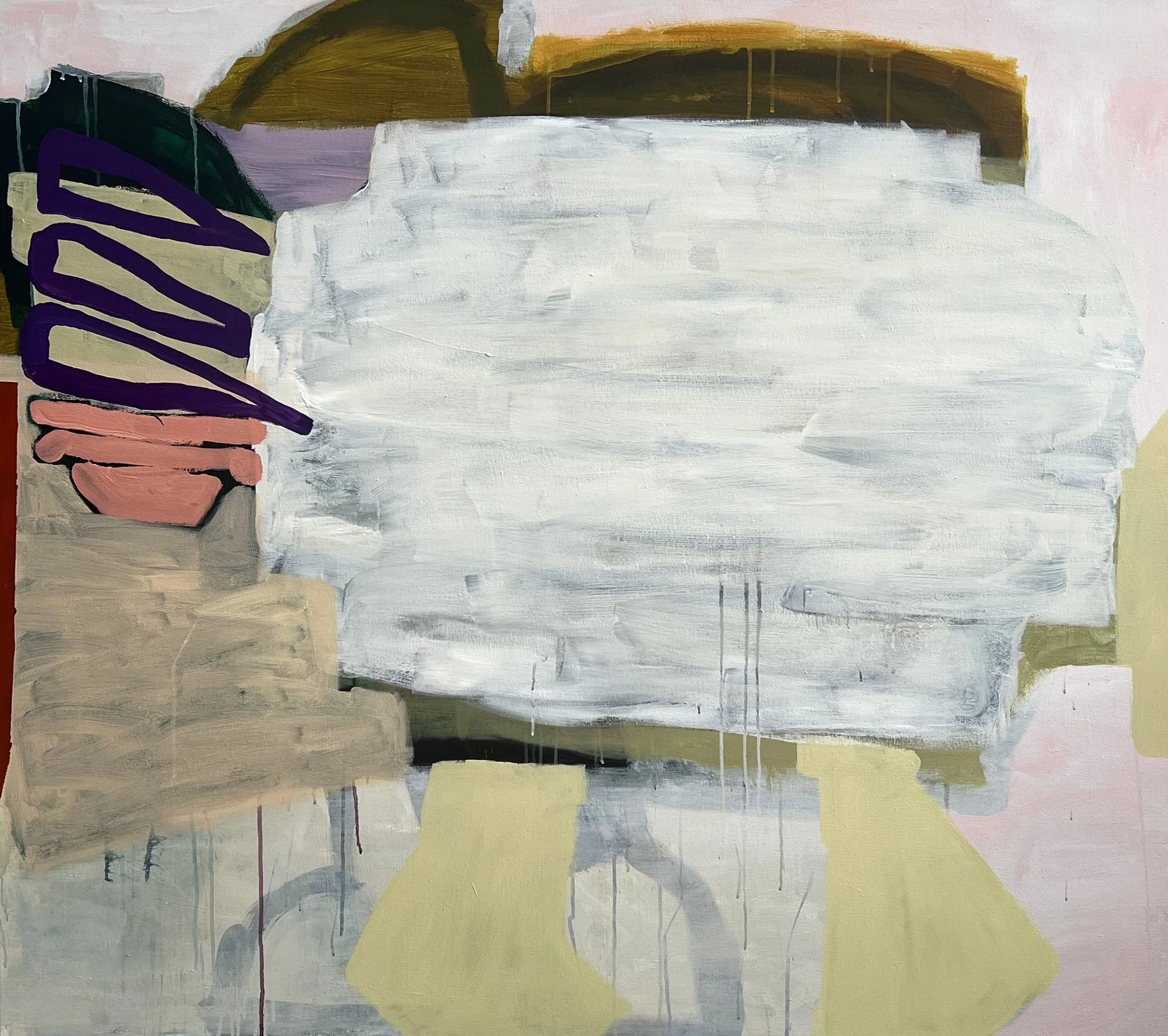
Mothership, 2026 127x152cm
How long do your paintings typically take, and have you ever abandoned a work only to return to it years later?
Anything for a day or two to years. I often reach the “conclusion” of a painting, whether positively or negatively, only to look at it months or years later and realise I am not done with it yet.
Is any work, then, ever completely finished? Is there always the possibility for more?
Willem de Kooning is credited with answering the question of when a painting was finished by saying, “when someone takes it away”. I think that’s true for me. But also there are paintings that I recognise I am done with.
I love your kitchen table sculptures. How did they come about? What’s the significance to you of making them at night and using found materials?
I was looking for a subject, a prop, something to paint that wasn’t recognisable. I went for a walk and picked stuff up that I came across, things discarded in the gutter. I went home, tipped everything out on the table and started making things. They didn’t work as subjects but the manner of their making…wedging, wrapping, balancing, etc. started to inform the way I was painting and I’ve maintained an intermittent engagement with this since.
How does the wedging, wrapping, balancing translate into the painting process?
It’s how it feels to paint. I can sense I am wrapping paint around paint, or balancing forms on top of one another
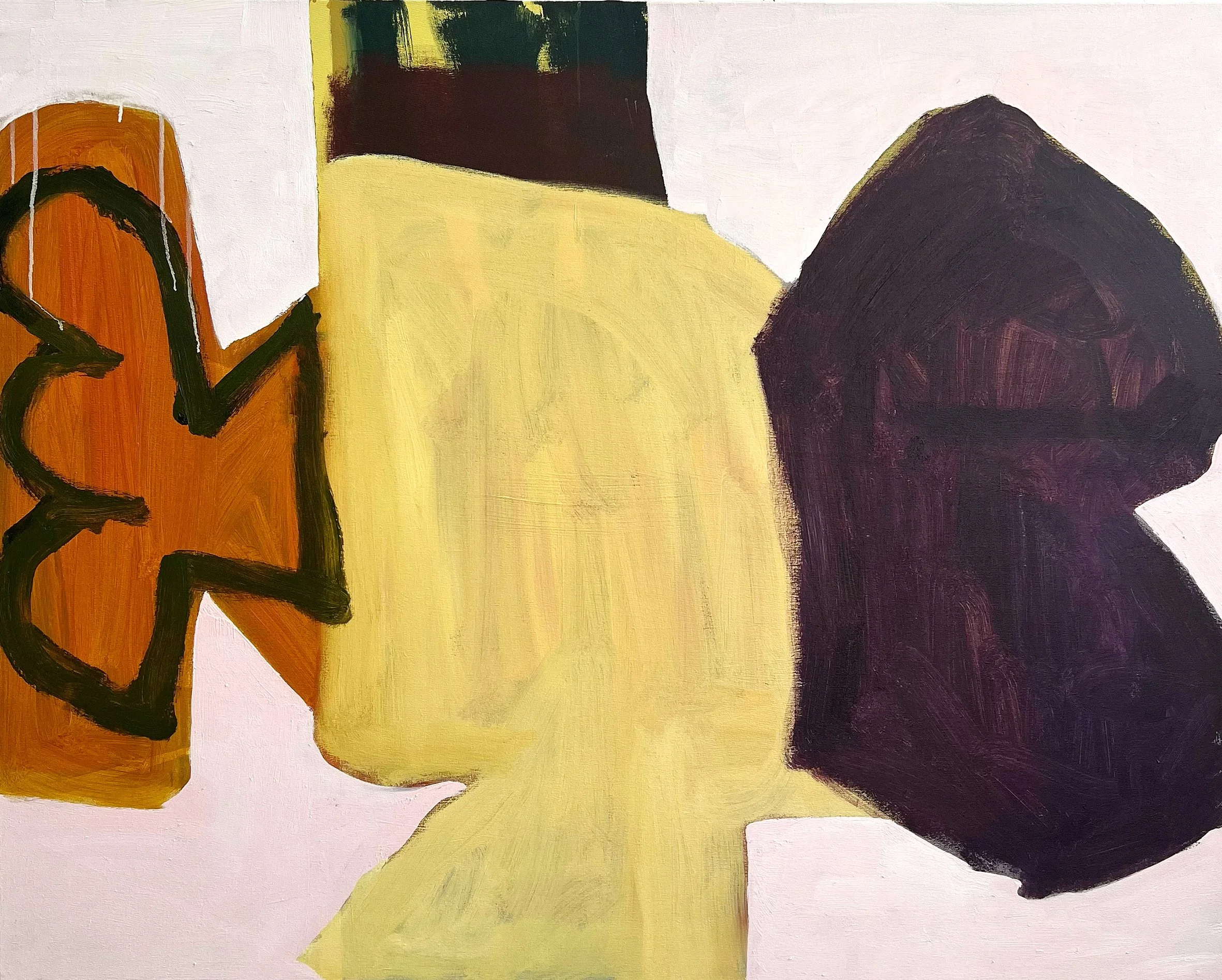
Dumb Ritual, 2024
100x125cm
Finally, a question we like to ask every artist, do you have any studio rituals that you do when starting or finishing a piece / do you have a way of marking transitions or changes?
I’m sure I have habits, but I’m not sure there are rituals in particular. I guess I usually try to arrive at the studio with some other things to do, that aren’t painting. Whether that be catching up on emails, a book I want to look at, or the usual admin of a painter’s existence…ordering materials, wrapping work and so on. Focusing on these things initially, allows me to edge into painting rather than meeting it head on.
Do you find starting difficult? What’s the benefit of easing into it over a more sudden start?
It isn’t that I find starting difficult. When I paint in the shed I am very able to begin work immediately. But there is something about being less intentional, about having a focus that isn’t painting that means I can edge into it and that feels necessary.
So, we end with the beginning. It seems that for Henry Ward, the place of making is never incidental, each site creates its own conditions. The shed allows immediacy; the table allows accumulation; the studio allows everything, in time. It is a practice built on patience and indirection, on edging towards things rather than confronting them. The forms that emerge, character-like, object-based, feel like the natural result of that disposition. Not images planned and executed, but shapes arrived at. Found, almost, like the things he picks up from the street and brings home to the table.