
Ewan is sitting in his studio, about five miles away from me. I am sitting in a soundproof box in our Farringdon workspace. We have never met, so, as Londoners, we begin the call the only way we know how: the weather. Today has been noticeably colder than the rest of the week, and Ewan tells me he shaved his head this morning and is now regretting it.
He disappears for a moment. He comes back wearing what I can only describe as a vintage leather cowboy hat, smiling. He tells me he's going to start wearing it more often, it blocks the sun and keeps his head warm. Two birds, one hat.
I confirm that this hat detail will in fact make it into the interview. Then we begin…
You've said your gilded map works are a form of "art-as-documentation", a snapshot of a landscape that could be completely rewritten within a decade. Do you think of yourself, then, as making historical records as much as artworks?
I think inevitably, because I’m making maps, I’m documenting a city at a particular moment in time. At the moment I’m working on a commission of Dubai, and when I went back to the mapping I had from 2017, I realised just how dramatically the city had changed. So I started compiling all the up-to-date roads and notable buildings.
I love looking at old maps too. You can disappear down a black hole looking at how a city has changed over hundreds of years.
At the same time, I’m removing many of the things we normally use to navigate a map — names, words and sometimes roads. Once those anchors disappear, something very precise and recognisable can become almost completely abstract.
That’s the tension I’m interested in: documenting a real place very accurately, while also creating an artwork that can exist independently of the map.
That’s so interesting! I wonder, then, do you think that a map removed from its function is appreciated enough? Do people see the beauty of a map without utility?
Absolutely. The more we use maps purely as functional tools, the more interesting it becomes to take one out of that context and put it on a wall in gold, silver or another material. Suddenly you’re looking at it differently.
I use Google Maps far too much myself — even to get from home to the studio! But once a map becomes an artwork, its function changes. For me it becomes about telling a story, whether that’s my story or the story of the person who owns it.
If it’s a commission, is it usually that they want a depiction of the present, of a space that they currently occupy?
Not necessarily. I started making these works in 2011, so with somewhere like Dubai, which has changed in a very short period of time, I now have maps from very different stages in the city’s development. People might want something current, but they can also be drawn to an earlier version of a place.
The map artworks actually began because I wanted to make a gift for my wife, Lucinda, centred on where I’d proposed to her. While I was working out how to do it, I came across medieval Mappa Mundi maps, which often placed a significant location at the centre, and also Charles Booth’s maps of London, which used colour to categorise people by socio-economic group.
That made me think about doing almost the opposite. Rather than separating people into categories or classes, what if everyone was seen as equal? I started thinking about gold — both because it’s precious as well as its association with the sacred.
So I centred the first map on the OXO Tower, where I proposed to Lucinda, made it circular (like the original medieval Mappa Mundi’s), removed all the street names and turned the spaces between the roads gold. It was only about 30cm across. I printed it and thought, “This looks pretty good!”
The following year I was selected for the RA Summer Exhibition and sold around 40 of them. That was really the beginning of it all.
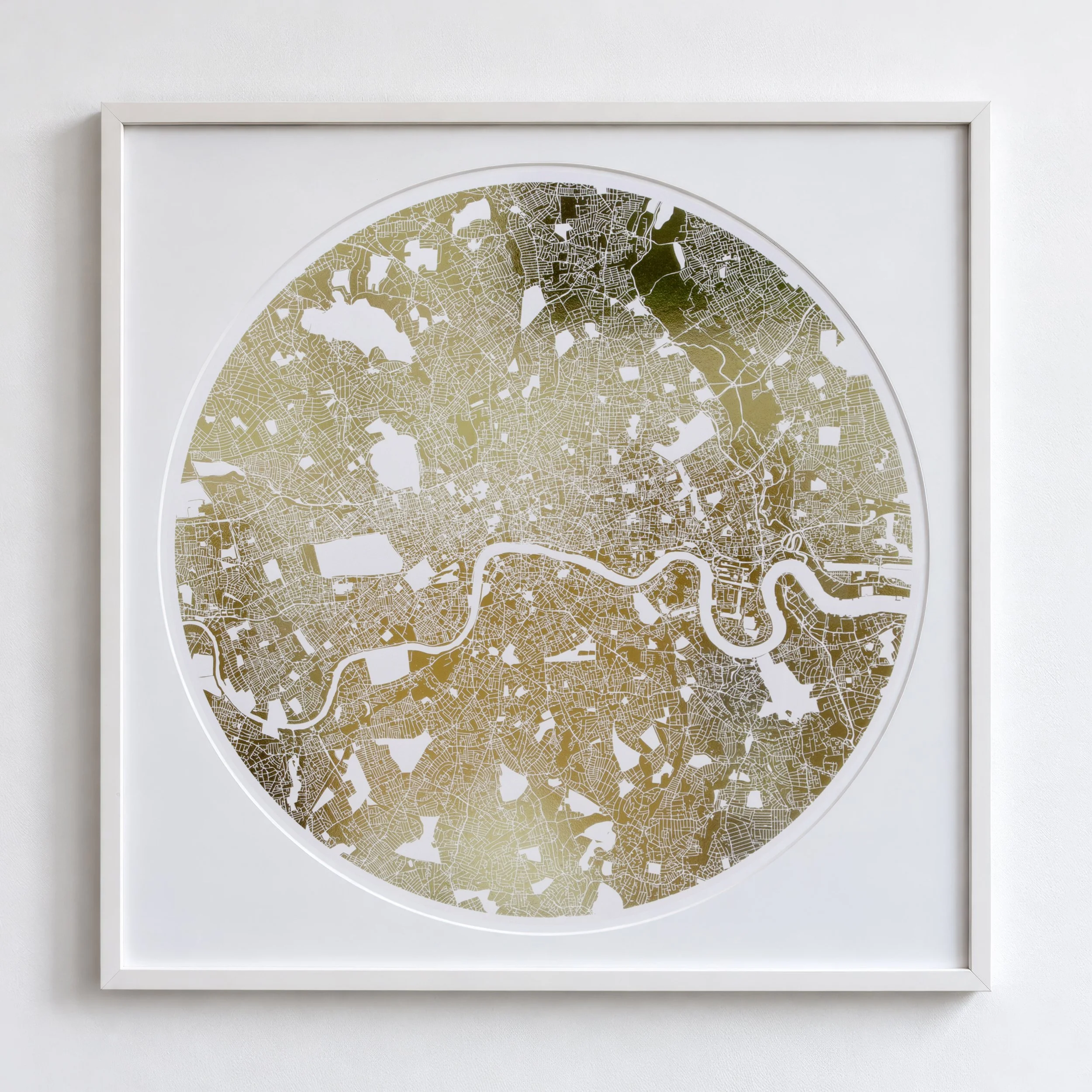
Mappa Mundi, London (White on Gold).
Okay, so your process involves an unusually high level of accuracy and precision, almost cartographic discipline, before the gold goes on. You mentioned the idea of opposites, do you enjoy the tension between that rigorous detail and the abstraction you're aiming for?
Absolutely. I love the idea that something completely real and precise can become abstract simply by changing the way you look at it.
I’ve probably made 600 or 700 maps now, and it still happens every time. When you remove names and the usual navigational anchors, you suddenly see somewhere from another perspective.
I love spending hours working on tiny details, and then stepping back and seeing something completely different. The Seine in Paris, for example, can suddenly look like a splat of paint thrown across a canvas. I love that transformation.
How do you know where to begin, would you start with a big river, or choose a central point? Is there a formula that you use or is it different for every place?
It’s definitely different for every place. I can spend days working on a city and then realise it isn’t right and start again. There’s something inherently uncertain about the creative process. You try to control it, but you also have to leave room for things to happen along the way.
Sometimes I’ll begin with roads or buildings and realise it needs water or parks, or that I need to strip something back. It’s never quite the same.
At the moment, for instance, I’m trying to create a particular bronze colour. There isn’t really a bronze leaf that gives me what I want, so I’m having to experiment and make mistakes. There’s frustration in that — “arghh, why haven’t I got there?” — but there's excitement because I might be the only one who’s done it.
So do I have a starting point? Sometimes. But I quite like not knowing exactly where I’m going to end
Let's talk more about Charles Booth's 1889 ‘Descriptive Map of London Poverty’ seems to have been a real turning point for you. You took a document built entirely on class divides indicated by colour and flattened it into a single gold. Was that decision to erase the hierarchy a political one for you, or more of a formal, aesthetic instinct?
I don’t set out to make political work. Of course I have my own political views, but that isn’t where the artwork begins.
With the Booth maps, what interested me was taking something that divided people into categories and doing almost the opposite — using one material across the whole city.
I’ve made works of places such as Kyiv, Moscow, Palestine and Jerusalem, but I’m conscious that I’m looking at those places from the outside. I’m not trying to make a political statement about somewhere I don’t live. For me it comes back to people, place and the idea of equal value.
So do you think in general, there’s an inherent political weight to a map or can a map just exist as a document or a piece of art, is it people that put weight onto it?
I think it’s always about people. A map can carry all sorts of political meanings depending on who is looking at it and what is happening in that place, but I don’t make my work as a political statement. I’m interested in making something beautiful that holds a story.
And art can sometimes outlive the political circumstances in which it was made. You can read about a king in a history book, but often it’s the image of them that stays with you.
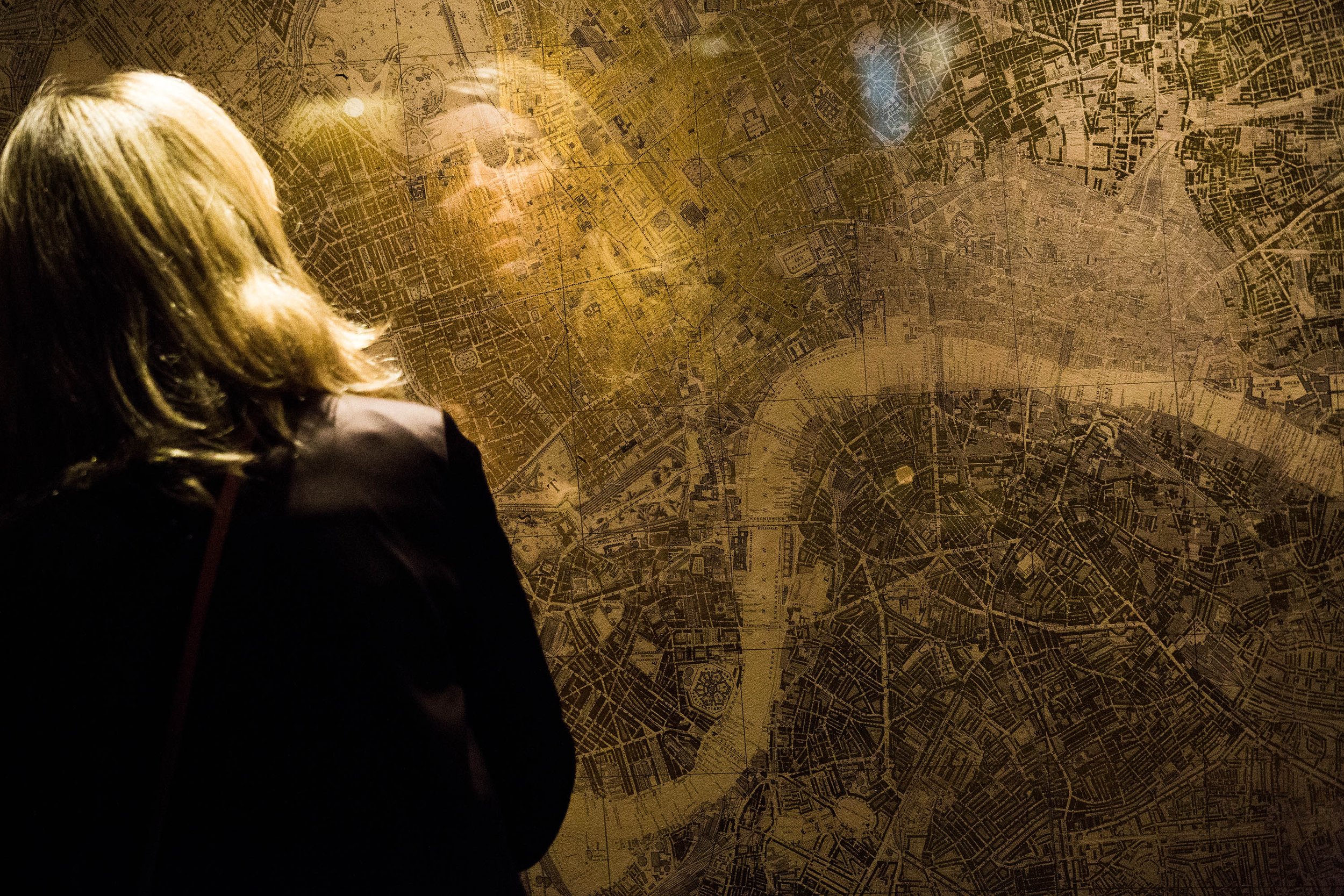
Sacred Booth at 45 Park Lane.
Do you think that art enables certain images or periods to stay alive beyond their context, that maybe a map as a document or a piece of artwork is able to outlive political tension as a testament to something?
I think so. Coming back to Dubai, you can already see enormous change between the maps I made in 2011 and the city today. Each work becomes a snapshot of a particular moment.
I like the idea that somebody might look at one of them in 200 years and see not only an artwork, but a record of what that city looked like at that point in time.
So you’re recording a timeframe rather than making a statement?
There is a statement in the sense that, when I make Moscow or Kyiv in gold, I’m using the same precious material for everybody. For me it’s about people being valuable and sacred, without creating a hierarchy between them.
That idea has become much more personal for me through my youngest son. He’s six, he has Down syndrome, is non-verbal and he lost his left leg after becoming very ill when he was two.
Having him in our family has made me understand much more deeply that someone doesn’t have to communicate or experience the world in the same way as everybody else to have enormous value. The world might see him as different; we see him as an absolutely integral part of our family, and our lives are richer because of him.
Wow. I guess before I was seeing your answer, ‘everyone is the same’ in a political equality kind of way, but actually it's more than that, it’s that everyone has so much to give and everyone contributes, and that in itself is a really special thing.
Yes, whether my youngest can talk or not, he gives to the world.
That’s so lovely! Can we explore this idea of gold more, you spoke about the symbolic weight, the value, sanctity, permanence. Also, the contradiction in the tension between gold as a long-lasting, preserving material and the idea that the landscapes that you’re putting into gold are themselves constantly changing and fluid. Is that another fun tension for you? Is there more significance to using gold as a material?
Yes, definitely. Gold has this extraordinary symbolic weight. It’s precious, it’s given as a gift and it has this long association with sacred objects and spaces.
I also use platinum, palladium, silver, copper and other metals, but I particularly like the tension with gold. Cities are constantly changing, whereas gold feels permanent. In the work, it almost holds a particular moment in place.
It’s almost like the gold forces people to recognise the value in even just a record of a place…
Exactly. It’s about the value of the city, but also the value of the people living within it. That’s really why I use precious metals.
You mentioned your work in a variety of materials, gold but also palladium, silver leaf, you create light boxes. How do you choose which work or city to present in what medium?
It really depends on the city and where the artwork is going to live. Most of my cities happen to look very good on gold, but I’ll experiment with different materials before deciding.
London, New York and Paris work in lots of different finishes. I also made two large black-and-white artworks of Kuala Lumpur and Malaysia for a hotel in Kuala Lumpur. Sometimes gold can be too strong for a space; somewhere else, silver might disappear completely.
So it’s partly the map itself and partly the environment around it.
Are there certain features of a city you look for or get excited about? Has map making impacted the way you interact with places?
Definitely. I’ve travelled a lot, and although there are places I’ve mapped that I’ve never visited, making the work changes the way I look at places.
I’ve lived in London for over 20 years but I grew up in the countryside and now whether I’m walking through a city or along a country path I find myself thinking, “I wonder what this looks like from above?”
I recently mapped Amsterdam. I’d been there several times, but it was only when I made the artwork that I really noticed these beautiful patterns created by the canals. In American cities you get the grids; in London you can strip away the minor roads and suddenly spot an old Roman road running through.
You begin to see the history of a place in its patterns. I think map-making has trained me to look for those stories.
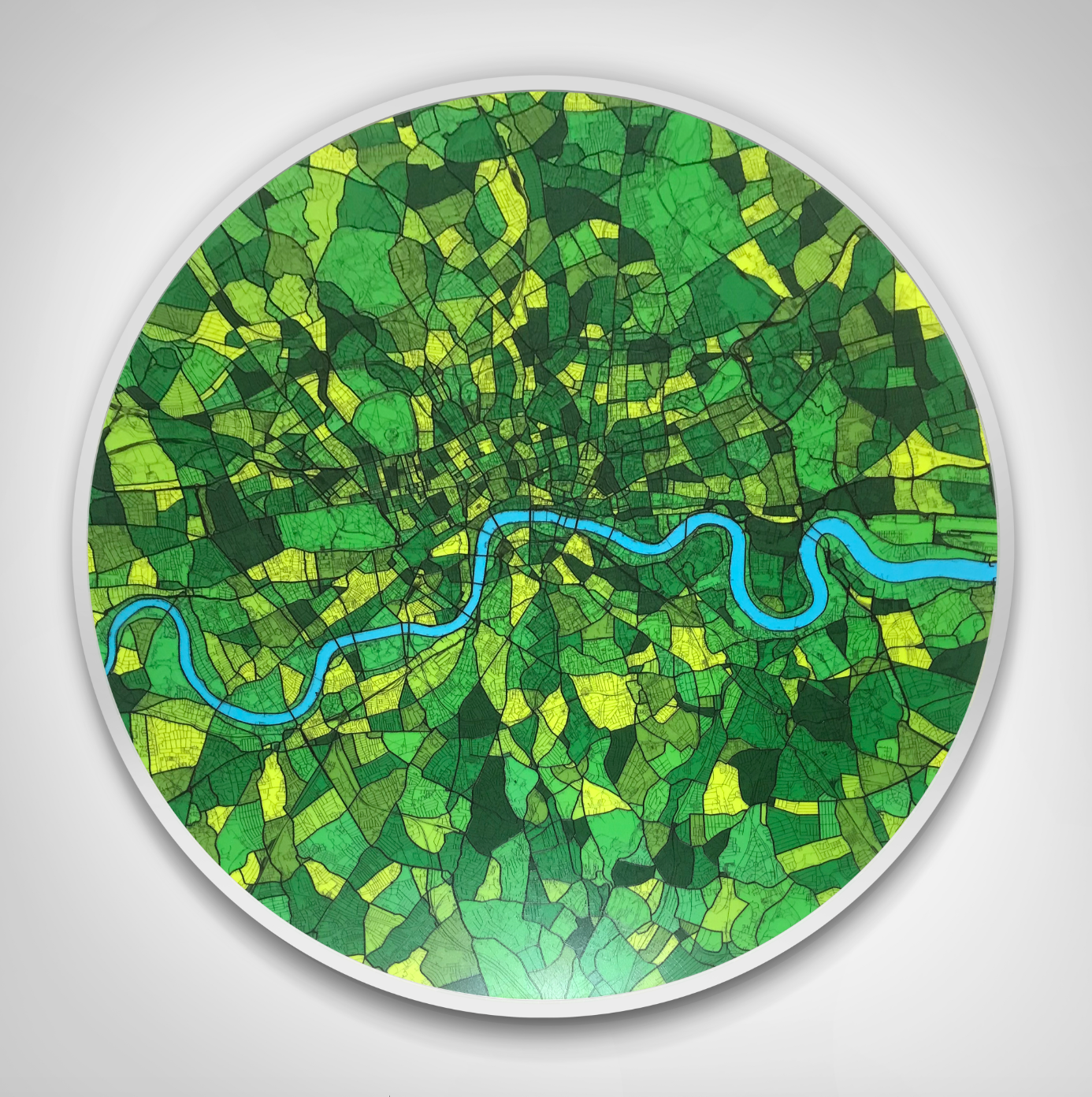
London Fields, 2019, Light Box.
That’s so cool, there’s probably loads of things that are revealed about the way a place has been constructed, which if you purposefully look for, you would miss because there would be too much noise. So actually, in the stripping away of things, you might reveal much more than you would with all of the detail. There’s another opposite for you!
Exactly! I’m going to take that.
So you’ve worked with Ackerman Studios on multiple projects: a show at 45 Park Lane, Mappa Mundi at 45 Park Lane in London, ‘Sacred Scenery’ at Holland Park, a Memorial Houston Medical hospital commission, and a commissioned piece for the Artist’s Bar at The Dorchester. This goes back to what you were saying earlier about using certain materials for a specific space, do you think the meaning of a piece shifts for you depending on where, or how, people encounter it?
Absolutely. It’s always a partnership between me and whoever has commissioned the work or is presenting it and I’m very conscious of where an artwork is going to live.
The Memorial Houston Medical hospital commission is a good example. I was thinking about the people who would actually spend time in that space, and I wanted to make something that might create a sense of calm or wonder.
Likewise, the piece at The Dorchester is centred on The Dorchester itself. I like there to be a relationship between the artwork and the place or person experiencing it.
I wouldn’t choose somewhere randomly. There needs to be a reason for that particular map to be there.
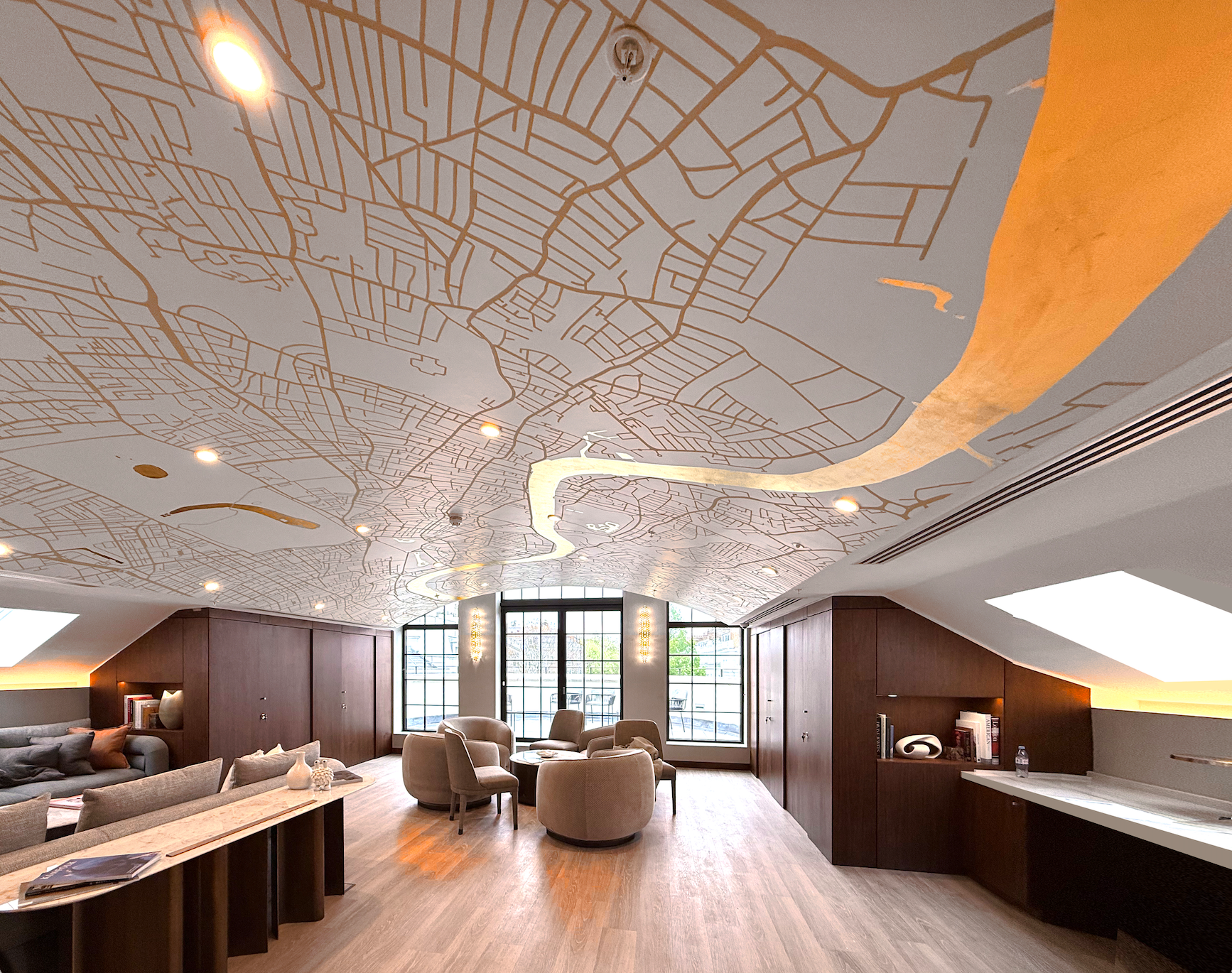
The Memorial Houston Medical hospital commission.
How do you think your practice has developed with time and how do you see it changing in the future? Is there a city, or a kind of map, you haven't tackled yet but want to?
I’m constantly learning and trying to push what I can do. We’ve talked mainly about maps, but I also make work that aren’t map-based, and I think it’s important for me not to become too fixed.
My mind is always flitting between ideas. I might go to an exhibition and see something that triggers an idea, or hear a song in a café and wonder whether that feeling could somehow become part of an artwork. I write music and poetry as well, and sometimes those things feed back into the visual work.
I enjoy the uncertainty of trying something I haven’t done before. It might be finding a particular colour, developing a new process, or even making something funny simply because it brings me joy.
The way I make work now is already very different from five years ago, and I hope that keeps happening.
How has it changed?
Technically, I understand so much more now — gilding, printing, painting, how the works are constructed, hung and transported. That knowledge means I can imagine something and have a much better understanding of whether it can actually be made.
Technology has changed things too. Even the bronze finish I’m experimenting with at the moment involves materials and processes that I simply wouldn’t have had access to five years ago.
But one of my bigger ambitions is actually about people. I’d love eventually to use what I’ve learned to help artists who are where I was 15 or 20 years ago. The art world can feel quite ambiguous when you’re starting out.
I’d love to have a big space where people could come together, make things, learn from one another and feel encouraged to keep going.
Do you think that working at a gallery helped with knowing how to navigate the artworld when you then became a full time artist?
Absolutely. Alongside my art degree, working at Flowers Gallery gave me an incredibly useful foundation.
I was there for 7 years, starting as an intern and eventually working across management and design. Being immersed in that world five days a week taught me a huge amount — which exhibitions mattered, where opportunities came from, how galleries worked and also some of the pitfalls.
I’m still in touch with people I worked with there and I’m very grateful for that period.
It can feel quite daunting sometimes in general, the ‘art world’. There are some invisible rules that everyone knows but no one ever says, so if you don’t know them, it can be quite hard to figure them out on your own
Absolutely! My BA in Bath was a great course, but you were basically thrust into making whatever you wanted to make. Then you enter the art world and realise there are all these unwritten rules. It can feel a bit like the Wild West.
But once you find your way into it, there are some genuinely lovely people. Lily is a great example.
So true, so true!
I really enjoy working with Lily and with the galleries and consultants around me. Sometimes someone will simply say, “This doesn’t work,” and that’s genuinely useful. I’d much rather have that honesty.
There’s a partnership there. Everybody wants to work out how to make something as good as it can be.
I love being in the studio making things, but I also really enjoy that collaboration with the people on the other side of it.
You’re right there are so many nice people, and I guess because everyone is generally interested in art and wants to be in that world, then you automatically get a lot of lovely and like-minded people. Okay, last question! This is one we like to ask every artist, do you have any studio rituals when starting or finishing a piece? Some way of marking the moment a map stops being a document and becomes an artwork?
No…
We both laugh
Not a formal ritual, anyway. It’s funny you should ask because somebody in the studio downstairs was throwing away what looks like a yoga gong. After you sent me the questions I thought, maybe I should start hitting it every time I finish an artwork.
There are processes I repeat, of course, and I suppose familiarity eventually becomes its own sort of ritual.
But no dancing around the room (yet).
The first time you made that map for your wife, how did you know where to end or what to take out?
I tend to start big and crop down. With that first map, I think I basically went onto Google Maps and started taking screenshots of London. It took weeks.
Actually, I don’t think I even gave Lucinda the gift on the day because it wasn’t ready!
You did the classic, ‘It's on its way’...
Hahaha, yes!
The original version was Greater London. It looked good, but there was simply too much information. I wanted to be able to notice individual roads and paths rather than feel overwhelmed by the whole thing.
So I kept zooming in until I found the right balance. That first crop really became the basis for the works that followed.
We laugh. There's something fitting about that, an artist whose practice is built on precision and patience, whose gilded cities will outlast us all, who didn't quite finish the very first one in time. The map, like most things Ewan makes, was worth the wait.
Long after we've said goodbye, I find myself thinking about something Ewan said, that his youngest son, who the world might see as different, gives to the world simply by being in it.
In stripping away the noise and removing the hierarchy, Ewan’s maps show us that what's left is something golden. Something that was always there.
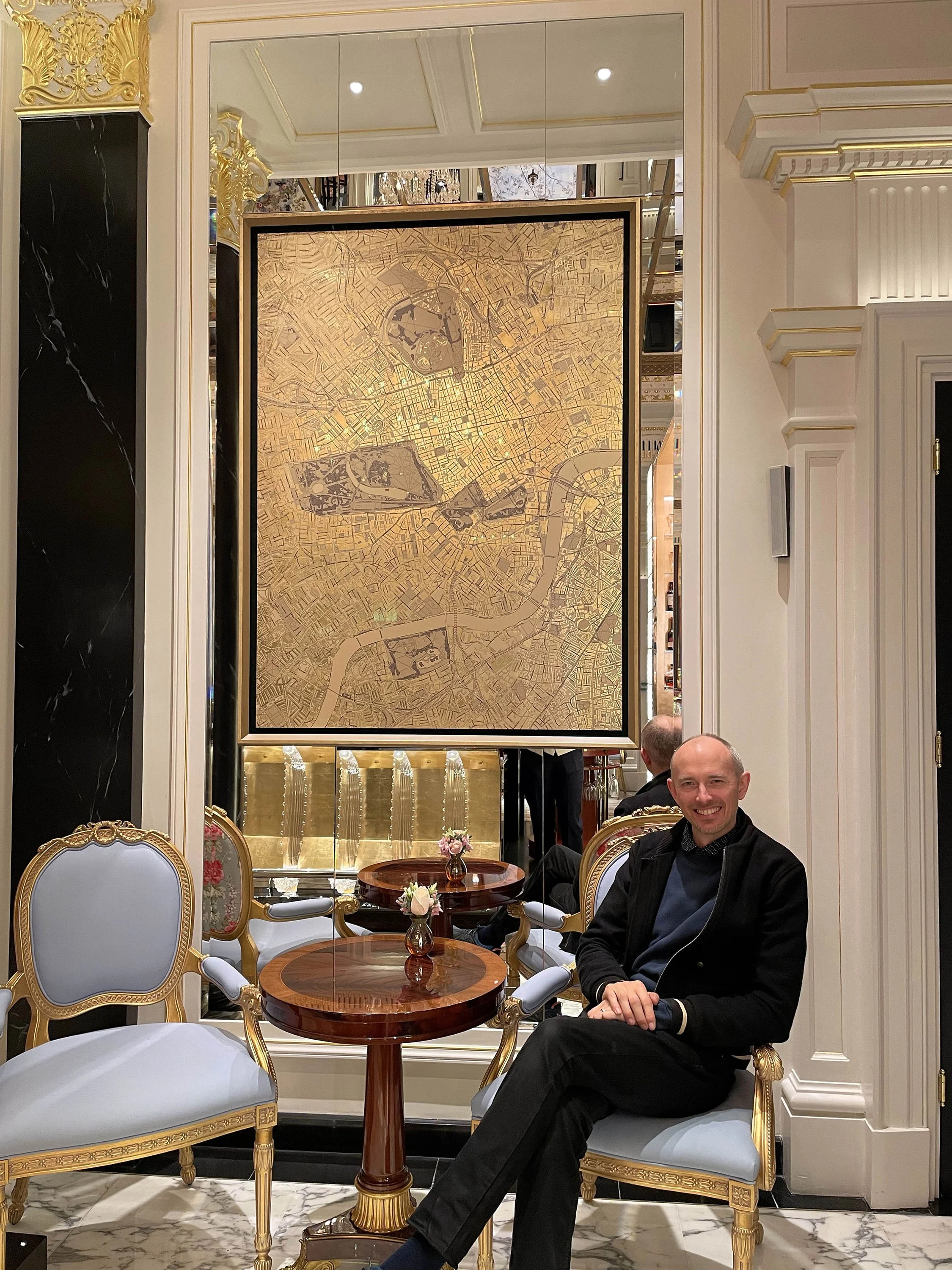
Ewan with ‘Sacred City’ at The Dorchester.